Architecture
This page describes the internal shape of PaloNexus’s authorization decision service — the component that answers, for every governed action, may this agent do this, on whose authority, right now? It is implemented as one Go binary (the component is named the control plane) that every request ultimately consults. First the decision spine and its invariants; then the Kubernetes deployment mechanics underneath — one way to run the service, not what the service is.
The decision spine
Section titled “The decision spine”The spine is internal/authz. Every request reaches it and the
handler dispatches on the X-Palonexus-Actor header — the headline path is agent
egress, with north-south ingress as the foundation underneath it:
- present →
serveEgress(the agent on-ramp — may this agent make this outbound call, on behalf of this human, for this task, right now?) - absent →
serveIngress(north-south, forwarded by Envoy’s external-authorization (ext_authz) filter)
Both paths call the same dependency packages in order:
| Package | Concern | On failure |
|---|---|---|
internal/identity | verify the bearer JSON Web Token (JWT) against the OpenID Connect (OIDC) JSON Web Key Set (JWKS) | 401 invalid credential |
internal/agentid | verify the agent Verifiable Presentation (VP) (egress only) | 403 identity failure / mismatch |
internal/registry | resolve the caller + target service | 403 unknown service / agent / target |
internal/policy | inline rules, then an Open Policy Agent (OPA) veto (deny-overrides); egress adds allowlist + budget + delegation | 403 deny (or 401 needs-approval on egress) |
internal/audit | append a hash-chained record of the outcome | — |
internal/metrics | bump the decision counter + latency histogram | — |
Read internal/authz/authz.go first — every other package
is a dependency of it.
The request path, end to end
Section titled “The request path, end to end”The diagram below traces a single request from the two entry points — a governed
agent pod through the egress forward-proxy (the headline path), and a north-south
client through the Envoy Gateway (the foundation underneath) — into the same
/authz decision. Read it left to right: both paths
converge on the :9191 decision listener, which runs the internal stages in order
(identity → registry → policy → audit → metrics) and only forwards to the upstream on an
allow (the bold edge). The dashed edges are the two identity sources the decision
consults but does not embed: the enterprise identity provider (IdP, OIDC) supplies human sign-in keys (JWKS)
and the workforce directory (Logto), while agent-idp verifies each agent’s
Verifiable Presentation.
The :8181 management API sits beside the hot path so operators and CI can read the
registry, audit, and metrics without touching the decision listener.
flowchart LR
  agent([Authority-bound agent pod])
  client([North-south client])

  proxy["Egress forward-proxy :9092"]
  gw["Envoy Gateway<br/>SecurityPolicy.extAuth"]

  subgraph cp["Control plane — one Go binary"]
    dec{{":9191 /authz decision"}}
    id["identity: verify JWT / VP"]
    reg["registry: resolve caller + target"]
    pol["policy: inline rules + OPA veto"]
    aud["audit: hash-chained record"]
    met["metrics: counter + latency"]
    mgmt[":8181 management API"]
  end

  idp[("Enterprise IdP / Workforce IAM<br/>OIDC · SCIM<br/>Logto")]
  aidp[("agent-idp<br/>did:web issuer, VCs")]
  upstream([Upstream: service / model / tool / peer])

  agent -->|HTTP_PROXY| proxy --> dec
  client -->|HTTP| gw -->|ext_authz| dec
  dec --> id --> reg --> pol --> aud --> met
  id -.JWKS.-> idp
  pol -.verify VP.-> aidp
  met ==>|allow| upstream
The two entry points (egress proxy and gateway ext_authz) converge on one /authz
decision; identity is verified against the enterprise IdP (OIDC) and agent-idp (Logto is the
first supported enterprise IdP), and only an allow reaches the upstream.
Design invariants
Section titled “Design invariants”These hold across the whole decision service — do not break them:
- Deny-by-default / fail-closed. Every unknown, every failure, every unreachable
dependency denies. An unreachable OPA denies; a timed-out egress-approval hold
transitions to
expired(a deny). - Deny-overrides policy. Inline allow + OPA deny = deny.
- Identity propagation, not token forwarding. On an allow the control plane stamps
X-Palonexus-Subject/-Upstream(and-Actor/-Agent-DIDon egress); upstreams trust the edge. - Verifiable authority trail. The hash chain is the integrity guarantee — each
record is tamper-evident;
/v1/audit/verifyrecomputes the chain and reports the sequence where it first breaks. - Same image everywhere. All behavior is env-driven (see Environment variables); the dev overlay simply removes the OIDC env vars to allow anonymous passthrough while policy still enforces public-vs-private from the registry.
Deployment mechanics (Kubernetes)
Section titled “Deployment mechanics (Kubernetes)”Everything below is how the decision service is deployed on Kubernetes — listeners, namespaces, network policy — not what it decides. Operational detail lives in Operating the control plane and Credential-Safe Action Enforcement (Ops).
Two listeners (plus the egress proxy)
Section titled “Two listeners (plus the egress proxy)”The control plane runs two HTTP listeners, deliberately split so the data path can be locked down mesh-only while the management API is exposed separately:
| Listener | Default addr | Purpose |
|---|---|---|
| Decision / ext_authz | :9191 (DECISION_ADDR) | the /authz hot path the gateway calls |
| Management | :8181 (MGMT_ADDR) | registry CRUD, /v1/audit, /v1/egress/requests, /metrics, /healthz, /readyz |
A third listener — the egress forward-proxy — is started only when
AGENT_IDP_URL is set (it needs the IdP to verify agent identities):
| Listener | Default addr | Purpose |
|---|---|---|
| Egress proxy | :9092 (EGRESS_PROXY_ADDR) | a standard HTTP forward proxy that runs the same egress decision before forwarding any outbound agent call |
The egress proxy is fronted by the egress-proxy.palonexus.svc:80 Service; agent pods
are pinned to reach only it. See Credential-Safe Action Enforcement.
┌──────────────────────────────────────────┐ │ CONTROL PLANE (one Go binary) │ │ │ agent pods ──────────▶ :9092 egress forward-proxy (same decision) │ │ gateway ──ext_authz──▶ :9191 /authz (decision hot path) │ │ │ operators / CI ──────▶ :8181 registry · audit · egress · /metrics └──────────────────────────────────────────┘For the precise routes on each listener, see the HTTP API reference.
Namespaces and trust zones
Section titled “Namespaces and trust zones”The platform deploys into three namespaces, each a trust boundary:
| Namespace | Contents | Role |
|---|---|---|
palonexus | control-plane, OPA, Dex, OpenTelemetry (OTel) collector, model-broker, portal, egress proxy | the control layer |
apps | the authority-bound agents, upstream services, runbooks-api, incy | the workloads being governed |
observability | Grafana LGTM (Tempo / Prometheus / Loki) | telemetry sink |
agent-idp runs in its own agent-idp namespace so its did:web issuer Decentralized Identifier (DID) resolves
at a stable in-cluster name (did:web:agent-idp.agent-idp.svc).
NetworkPolicy is part of the design, not an afterthought. Agent egress is confined
to DNS + agent-idp:8090 + egress-proxy:80 only — the direct paths to the
model-broker, runbooks-api, and peer agents are removed, so nothing reaches a target
except through the proxy (which routes it through /authz). The Envoy Gateway is the
only component intended to take external client traffic, and every request through it
is gated.
Consoles
Section titled “Consoles”PaloNexus deliberately splits its UI into focused portals. None is exposed to the
public internet. Each is reachable only over the organization’s Tailscale tailnet (the
production path) or via kubectl port-forward (the local fallback). make port-forward
opens all of them at once.
| Portal | In-cluster | What it’s for |
|---|---|---|
| Control-plane console | svc/portal:3000 (ns palonexus) | the operator cockpit — the tabs below |
| Grafana (LGTM) | svc/lgtm:3000 (ns observability) | traces with DID / Verifiable Credential (VC) attributes (Tempo), decision/latency/token/cost metrics (Prometheus), audit/log search (Loki) |
| Incy (optional backdrop) | svc/web (ns incy) | a realistic site-reliability-engineering (SRE) incident-management app the agents can act against |
Control-plane console — the tabs
Section titled “Control-plane console — the tabs”| Tab | Shows | Backed by |
|---|---|---|
| Overview (Authority Command Center) | the verifiable-authority-trail badge (live hash-chain verify), the agent fleet joined to accountable owners/departments, a live enforcement feed with deciding-layer + delegation chips, allow/deny counters | /v1/audit + /v1/audit/verify + /metrics, agent-idp /v1/governance/summary |
| Registry | every service / agent / model / tool: kind, allowlists, budgets, scopes, data-class | /v1/registry/services |
| Decisions | allow-vs-deny by target + a live decision table | /v1/audit |
| Authority Trail | the hash-chained log + Verify chain (tamper-evidence) | /v1/audit, /v1/audit/verify |
| Identity | the did:web issuer anchor + each agent’s did:key, capabilities, delegations, revocations | agent-idp /v1/issuer, /v1/agents, /v1/delegations, /v1/revocations |
| Authority Delegation | the human-in-the-loop console — Approve / Deny pending delegations, Revoke active ones | agent-idp delegation + revoke APIs |
| Credential-Safe Enforcement | held egress requests (actor DID, target, action, resource, reason, countdown) with Approve / Deny | /v1/egress/requests (+ /approve, /deny) |
| Agents | per-agent identity (did:key) + allowlist / budget + what was delegated, by whom, when it expires + usage | aggregated control-plane + agent-idp |
| Traces | embedded Grafana Tempo Explore for DID/VC-tagged spans | Grafana (GRAFANA_PUBLIC_URL) |
The Overview tab is the Authority Command Center: one screen answering, for the whole fleet, which agent acted, on whose authority, who approved it, was the approver entitled, what credential was issued, and was it later revoked — a live hash-chain-verified badge over the authority trail, the fleet joined to its accountable owners via the SCIM directory, and an enforcement feed naming the deciding layer on every record. How to read each panel is documented in Operate the Command Center.
The Authority Delegation and Credential-Safe Enforcement tabs are the two human-in-the-loop surfaces: Authority Delegation resumes a delegation (the regulated DID/VC runbook gate); Credential-Safe Enforcement resumes a held network call at the egress proxy. Both poll every few seconds and resume the waiting decision on approve.
The same console also carries the two enterprise-IAM surfaces — Directory and Governance — documented under Connect agents to enterprise authority. The Governance tab is where accountable ownership and the revocation cascade are visible: owners, sponsors, risk and lifecycle per agent, plus delegation authority and token exchange.
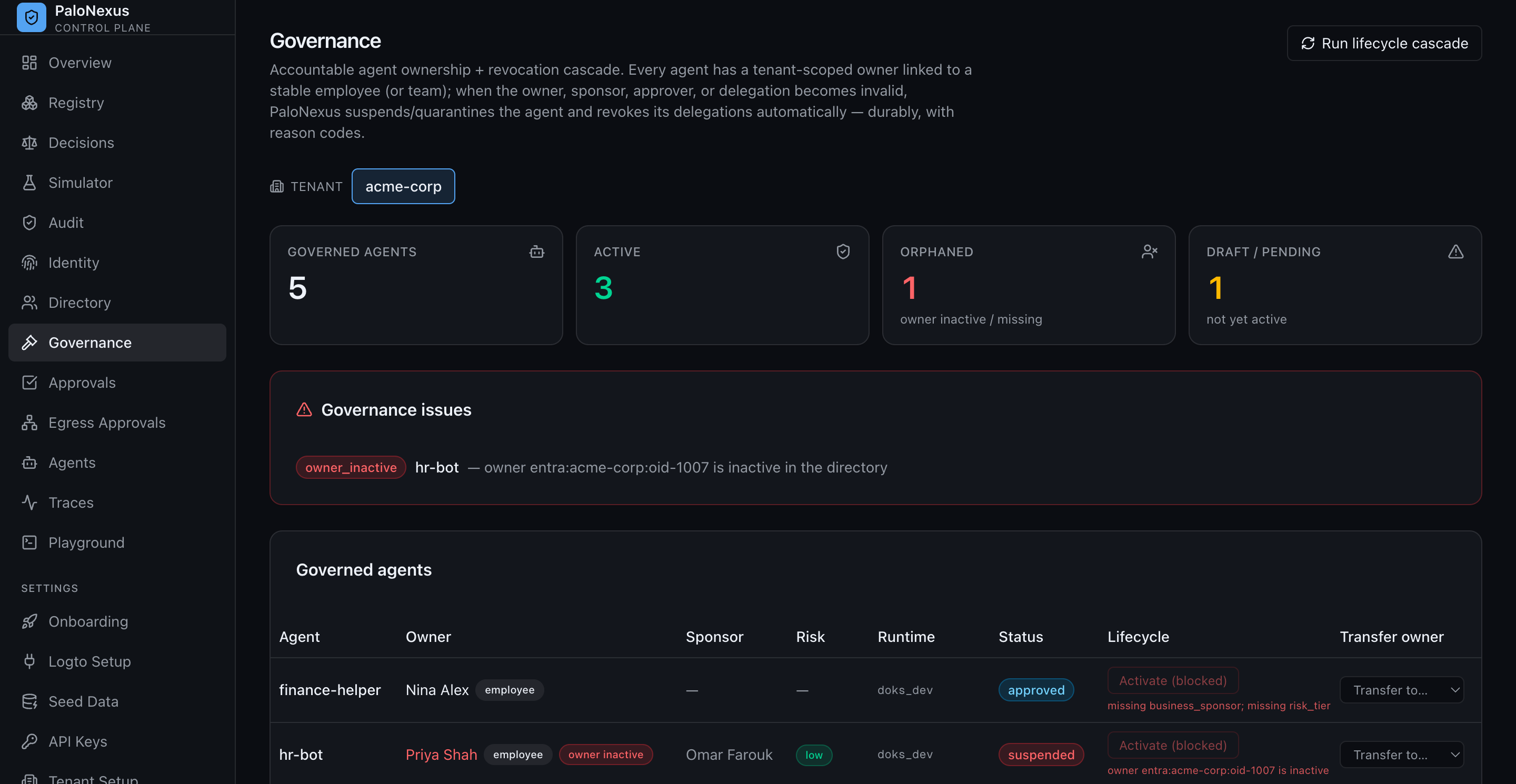
The Governance console: accountable agent ownership and the revocation cascade — owners, sponsors, delegations, and short-lived token exchange in one place.
The Decisions tab derives an allow-versus-deny breakdown per target straight from the
audit trail — every bar is a real ext_authz verdict:
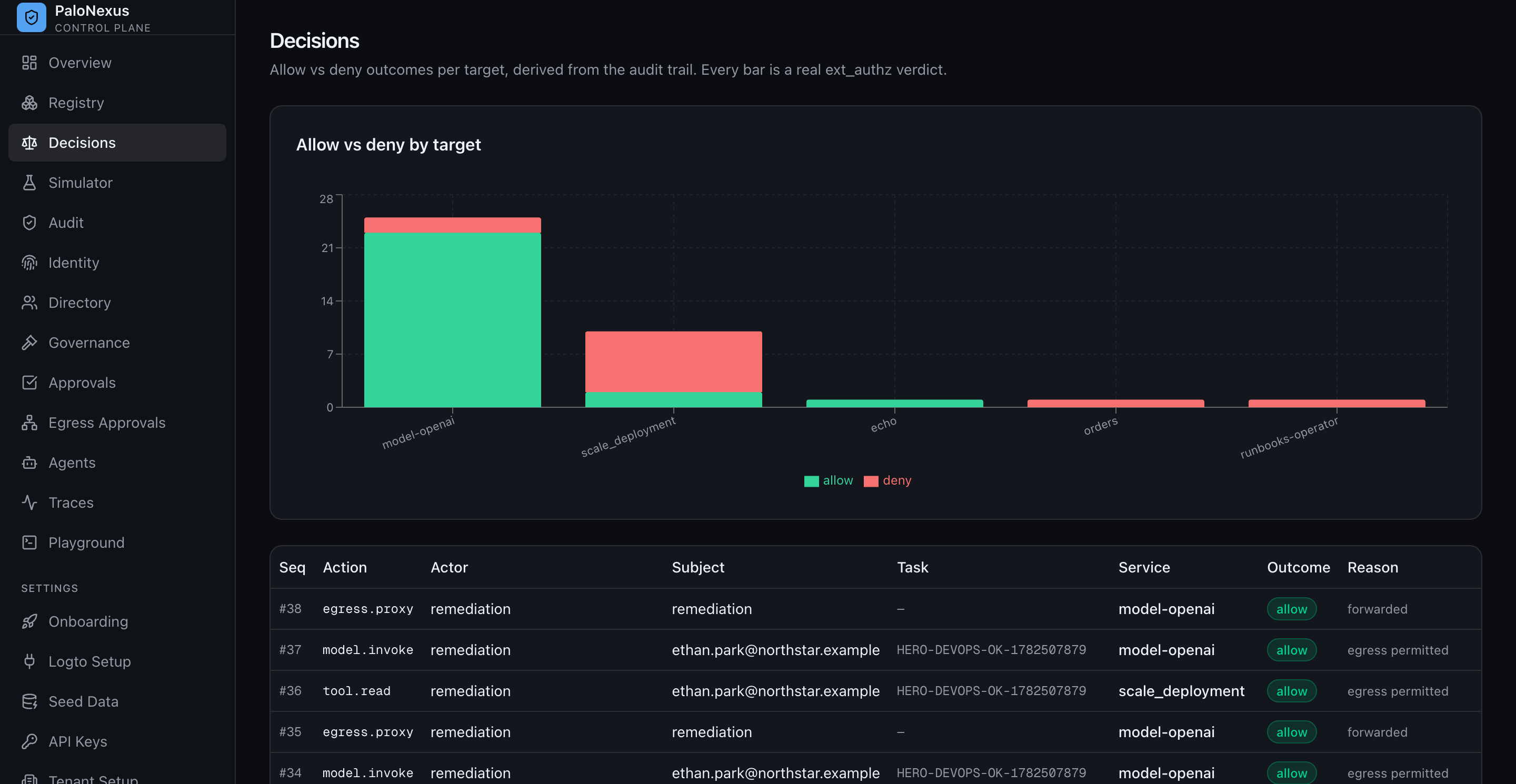
The Decisions console: allow versus deny per target, derived from the audit trail — every
bar is a real ext_authz verdict.
Screenshots of each tab live in docs/walkthrough/ in the platform repo (e.g.
01-overview.png, 04-audit-verify.png, 05-approvals.png,
05b-egress-approvals.png, 06-identity.png, 08-traces.png).
Grafana (LGTM)
Section titled “Grafana (LGTM)”A single-binary grafana/otel-lgtm deployment bundles Tempo, Prometheus, and Loki.
The control-plane and agent-idp emit OTLP spans carrying DID / VC attributes
(did, vcJti, decision), so a single agent task shows its model + tool + agent-to-agent (A2A) hops
on one timeline, each decided at the same /authz (“one trace, three gates”). The
portal’s Traces tab embeds the Tempo Explore view.
Exposure model
Section titled “Exposure model”- Tailscale is the intended access path. The portal and incy ship Tailscale node
manifests; set
TS_AUTHKEY(a Secret) to join them to the tailnet. If the auth key is absent the deploy still succeeds — a failed/absent tailnet never blocks the platform. - Port-forward is the always-available local fallback (
make port-forward): portal:3000, control-plane mgmt:8181, egress/authz:9191, agent-idp:8090, Grafana:3001. - The Envoy Gateway (north-south data plane) is a
LoadBalancerService — the only component intended to take external client traffic, and every request through it is gated by/authz.