Authority Delegation
Some actions are too sensitive for a standing credential. A low-trust agent should read only the specific runbook for the incident it is actively working, for only ~5 minutes, and only after a human approved that delegation. This is the human-in-the-loop layer.
The elevation flow at a glance
Section titled “The elevation flow at a glance”This is the central flow of the platform: an agent is denied a regulated target, opens a time-boxed delegation request, a human approves it (minting a short-lived Delegation Verifiable Credential (VC)), the retried call is allowed for exactly that task, and on TTL expiry or revocation deny-by-default reasserts. The temporary-elevation walkthrough runs this end-to-end offline on the sample organization’s seeded roles — the owner is the human the agent acts for, the sponsor the approver; here is the shape of it:
sequenceDiagram
    participant Agent as Agent (for the owner)
    participant CP as Control plane /authz
    participant IdP as agent-idp
    participant Approver as Approver (sponsor)
    Agent->>CP: check(runbooks:read, db-failover)
    CP-->>Agent: 401 needs-approval — no approved delegation
    Agent->>IdP: request_delegation(ttl=300)
    IdP-->>Agent: Delegation(status=pending)
    Approver->>IdP: Approve in /approvals console
    Note over IdP: mint Delegation VC — status=approved, notAfter
    Agent->>CP: authorize(runbooks:read, db-failover)
    CP-->>Agent: 200 allow — subject=ethan.park
    Note over Agent,CP: …TTL elapses or grant revoked…
    Agent->>CP: check(runbooks:read, db-failover)
    CP-->>Agent: 401 needs-approval — deny-by-default reasserts
Sequence: the deny → request → approve → allow → expire/revoke arc. Every hop is a
real /authz decision carrying the on-behalf-of subject; the approval is a named human
decision on the audit record, not a standing grant.
A delegation moves through a small, explicit lifecycle. Only the approved state
(while non-expired and non-revoked) makes /authz allow; every other state is a
deny:
stateDiagram-v2
    [*] --> pending: request_delegation(ttl)
    pending --> approved: approver approves (VC minted)
    pending --> denied: approver rejects
    approved --> expired: notAfter elapses
    approved --> revoked: revoke / cascade
    denied --> [*]
    expired --> [*]
    revoked --> [*]
State diagram: a delegation is pending until an authorized human decides it.
approved is the only state that authorizes a call, and it is time-boxed — it
leaves for expired (TTL) or revoked (live StatusList), both terminal denies.
Who can request, approve, operate, audit
Section titled “Who can request, approve, operate, audit”Separation of duties is enforced by the two-gate approval rule
(authority.py::decide): an approver must hold org:agents:approve and
covers_scenario (at least one of the scenario’s resource scopes). The owner who
requested the elevation does not self-approve. The cast below is the seeded
devops-incident scenario’s — the
temporary-elevation walkthrough
defines each role.
| Responsibility | Role (devops-incident) | Authority required | Notes |
|---|---|---|---|
| Request elevation | Owner (on-behalf-of) | the agent acts on the owner’s behalf; the owner holds deployments:* but not runbooks:read | the agent never holds more than the human it represents |
| Approve | Sponsor | org:agents:approve and covers DevOps (runbooks:read) | passes both gates ✅ — and is not the requester |
| Cannot approve | Auditor | holds org:agents:approve but covers Security only | outside_scenario_domain:devops-incident ❌ — can only audit |
| Cannot approve | Negative persona | no scopes; invariant-blocked from org:agents:* | hard-denied everywhere ❌ |
| Operate the task | Operator | runs the agent within granted scopes | no approval authority |
| Audit | Auditor | read the hash-chained /audit log | reviews who approved what, when |
Time-boxed Delegation VCs
Section titled “Time-boxed Delegation VCs”A dataClass: regulated tool target makes the egress decision require a valid,
approved, non-expired, non-revoked delegation for the exact
(actor, task, action, resource). There is no standing grant; each grant is a
single-link CapabilityCredential chaining directly to the did:web issuer — the
human approval is the root authority — with a short TTL.
The control plane checks this by calling agent-idp GET /v1/delegations/check
(the Go DelegationVerifier). When no valid delegation exists, /authz returns
401 with X-Palonexus-Needs-Approval: true. The middleware turns that into a
LangGraph interrupt() instead of failing:
if decision["needs_human_approval"]: interrupt({"action_requests": [request.tool_call], "reason": decision["reason"]})A human approves in the portal; the console resumes the graph via
Command(resume=...). The interrupt requires a persistent checkpointer.
Request → approve → use, by hand
Section titled “Request → approve → use, by hand”The egress decision the middleware would make carries the fine-grained
Action/Resource so the coarse allowlist gate and the cryptographic resource
gate check one delegation:
# BEFORE delegation -> 401 + needs-approval=true (deny, ask a human)curl -s -o /dev/null -w "%{http_code} needs-approval=%header{x-palonexus-needs-approval}\n" \ -XPOST localhost:9191/authz \ -H 'X-Palonexus-Actor: triage-agent' \ -H 'X-Palonexus-On-Behalf-Of: sre@corp' \ -H 'X-Palonexus-Task: INC-123' \ -H 'X-Palonexus-Service: runbooks-api' \ -H 'X-Palonexus-Target-Kind: tool' \ -H 'X-Palonexus-Action: runbook:read' \ -H 'X-Palonexus-Resource: runbooks-api:/runbooks/db-failover'# A human approves a 300s time-boxed delegation at the IdP.REQ_ID=$(curl -s -XPOST localhost:8090/v1/delegations/request -H 'content-type: application/json' -d '{ "actorName":"triage-agent","task":"INC-123","action":"runbook:read", "resource":"runbooks-api:/runbooks/db-failover","reason":"triage INC-123 5xx spike", "ttlSeconds":300}' | jq -r .id)APPROVE=$(curl -s -XPOST "localhost:8090/v1/delegations/$REQ_ID/approve" \ -H 'content-type: application/json' -d '{"approver":"sre@corp"}')VC_JTI=$(echo "$APPROVE" | jq -r .vcJti)# AFTER approval -> re-run the egress curl above -> 200 (allow)./v1/delegations/check returns ok=true iff an approved, non-expired
(notAfter > now), non-revoked delegation exists whose actorName, task,
action match and whose stored resource covers the requested one (trailing /*
glob).
The runbook DID/VC challenge-response
Section titled “The runbook DID/VC challenge-response”Holding a valid Delegation VC is necessary but not sufficient. At the resource —
the runbooks-api gate — the agent additionally performs a challenge-response
against its decentralized identifier (DID),
proving it is the live holder in the expected execution state (this ticket,
this scope), defeating stolen or replayed credentials. The SDK’s runbook_tool.py
does the two-step agentdid flow once a Delegation VC is available, attaching the
exec-state context (incy is the sample incident manager the ticket ids come from):
RunbookContext( identity=identity, delegation_vcs={resource_for(name): delegation_vc}, exec_state={"active_ticket_id": incident_id, "scope_in_use": "runbook:read", "task": incident_id, "ticketSource": "incy"},)This is why runbooks-api is registered dataClass: internal, not regulated: the
proxy does the coarse allowlist gate, and this fine-grained, per-resource gate runs
server-side. See Credential-safe action enforcement § layering.
The two consoles
Section titled “The two consoles”The portal surfaces two approval queues that share the same UI pattern (a 3s poll + React-Query invalidation):
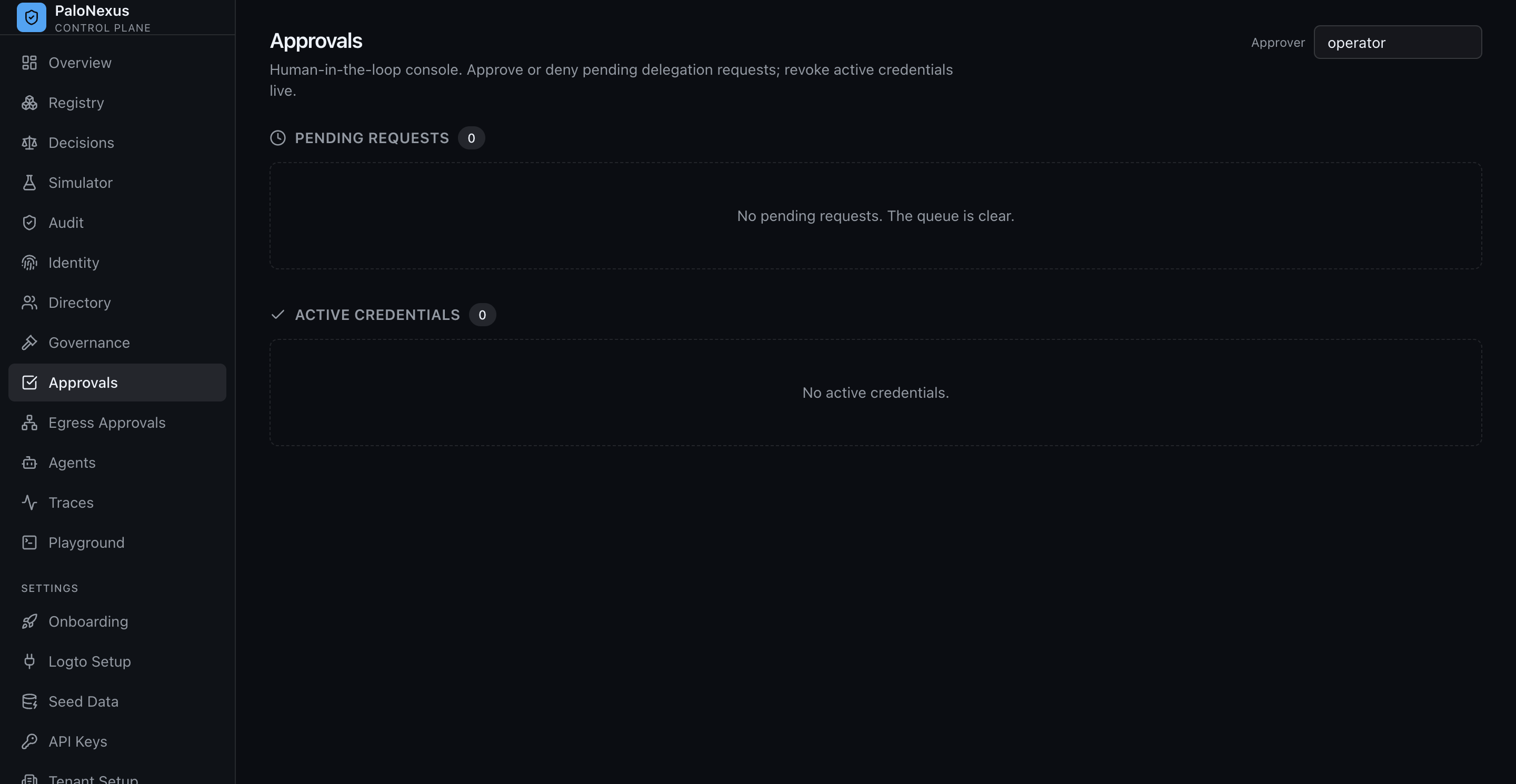
The /approvals console — the human-in-the-loop queue where an operator approves or
denies delegation requests. Shown here in its empty state: the queue is clear (no
pending requests), the resting state between elevations. Set the Approver field
(e.g. the seeded approver identity maya.chen@northstar.example) before approving;
that string lands on the delegation and the audit record.
| Console | Backs | Approves | When it fires |
|---|---|---|---|
Authority Delegation (/approvals) | delegation requests at agent-idp | a time-boxed Delegation VC for (actor, task, action, resource) | a regulated tool target needs a fine-grained, server-side-gated delegation |
Credential-Safe Enforcement (/egress) | the control-plane pending-egress queue | a single held egress request | a regulated target with no server-side gate (e.g. scale_deployment) is held at the proxy |
The Credential-Safe Enforcement path: when the proxy decision is needs-approval, it creates
a pending request and holds — long-polling its status up to
EGRESS_APPROVAL_TIMEOUT (default 120s). Approved → forward; denied/timeout →
403. The queue API:
curl -s localhost:8181/v1/egress/requests # list (newest first)curl -s -XPOST localhost:8181/v1/egress/requests/$ID/approve -d '{"approver":"sre@corp"}'curl -s -XPOST localhost:8181/v1/egress/requests/$ID/deny -d '{"approver":"sre@corp","reason":"…"}'Preview a decision before running it
Section titled “Preview a decision before running it”Before requesting (or approving) an elevation, dry-run the exact decision in
the Policy simulator (/simulate). Its Authority-preview tab answers a
design-time eligibility question — would persona P, on scenario S, be allowed
authority action A? — while the Live decision tab issues a runtime-faithful
dry-run against the real decision paths:
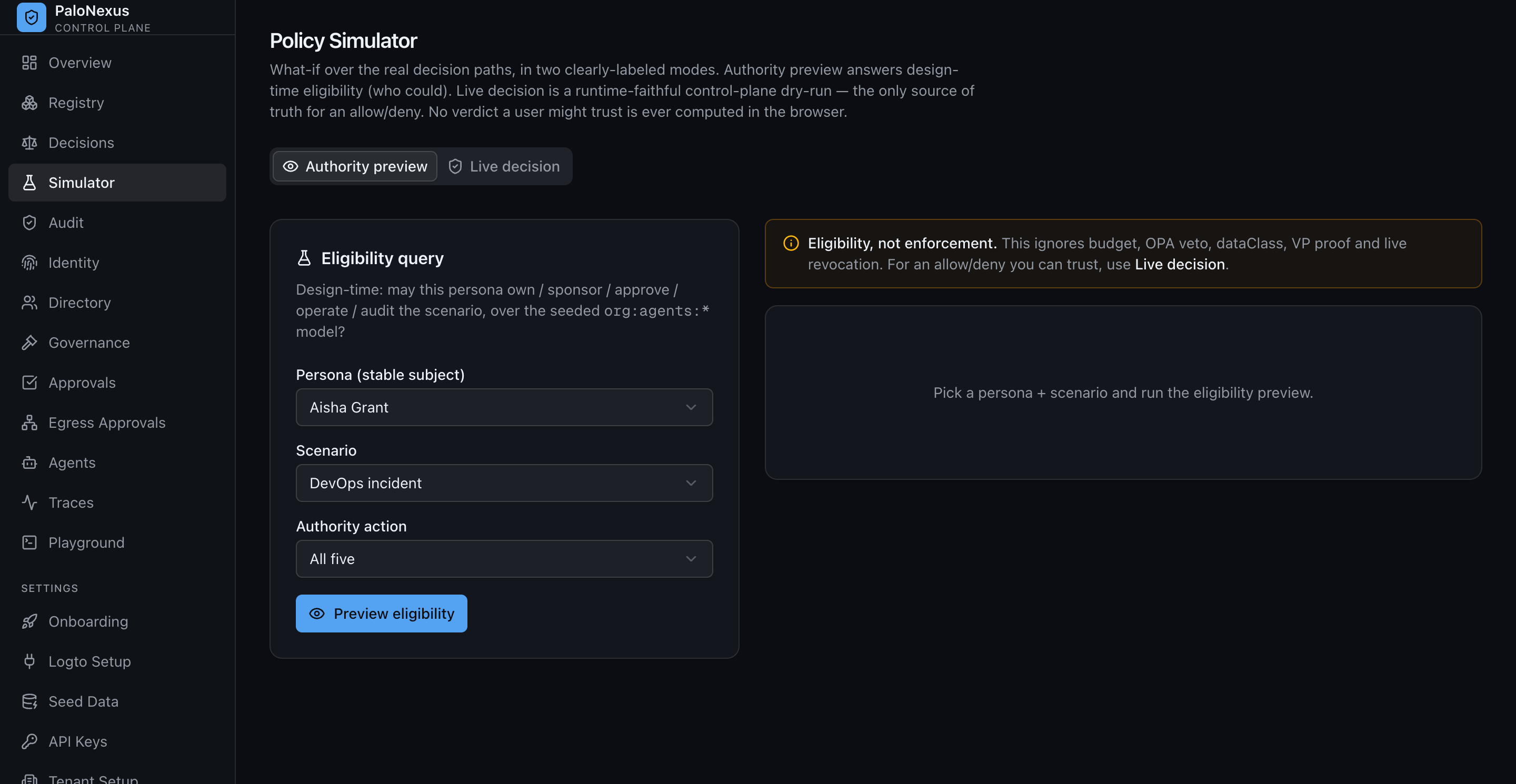
The /simulate console: what-if over the real decision paths. Use the
Authority-preview tab to check whether an approver passes the two-gate rule, but
trust only the Live decision tab for a real allow/deny — design-time preview is a
hint, not a verdict.
The live-revocation race
Section titled “The live-revocation race”A time-boxed delegation can be cut mid-flight, before it expires:
# Revoke the Delegation VC.curl -s -XPOST localhost:8090/v1/revoke -H 'content-type: application/json' \ -d "{\"vcJti\":\"$VC_JTI\"}"# The NEXT /authz for that delegation -> 401 + needs-approval=true again.Because /authz re-checks the StatusList on every call, revocation denies the very
next request regardless of remaining TTL. Prove the whole sequence —
deny → approve → allow → revoke → deny — with the platform smoke script:
./scripts/phaseB-smoke.shThe full multi-agent version of this, with a peer broker block-polling for the approval, is the autonomous flow.
See also
Section titled “See also”- Temporary elevation walkthrough — this exact flow, end-to-end and runnable offline, with the SDK error table and the elevation flow table.
- Accountable agent identity — how the agent the delegation is issued to gets its
did:key+ Membership VC. - Recipe: revocation race — revoke mid-task and watch the next check deny.
- Troubleshooting § SDK typed error tree — map
ApprovalRequired/DelegationExpired/CredentialRevokedto their fixes.