DOKS runbook — zero to authority-bound agent
This is the cold-start path: from nothing to an authority-bound agent — one whose
model, tool, and agent-to-agent egress is decided at the control plane’s
/authz — on any Kubernetes (DOKS shown), in under 30 minutes. It stitches
together the pieces that already have their own pages so they run in the right
order with the right prerequisites:
- Terraform / DOKS provisions the cluster, registry, and VPC.
- Self-hosting is the Kustomize deploy and the opt-in hardening components.
- Secrets is the never-in-image secret catalog.
- The
deploy-langgraph-agent-to-palonexusskill (platform/.claude/skills/) is the agent-deployment workflow this runbook’s Step 5 reuses.
Prerequisites & env/secret matrix
Section titled “Prerequisites & env/secret matrix”Have these ready before starting the clock:
| Tool | Why |
|---|---|
doctl (authenticated) + Terraform ≥ 1.5 | provision DOKS + DOCR (Terraform / DOKS) |
kubectl + kustomize (or kubectl kustomize) | apply the overlay |
helm | install Envoy Gateway |
| a reachable image registry | the cluster must be able to pull the platform images |
The platform is same-image-everywhere; every behavioural switch is an env var delivered via Kustomize + out-of-band Secrets. The minimum-viable set for a authority-bound-agent demo on the selfhost overlay:
| Secret / env | Namespace | Consumed by | Required for | Default if absent |
|---|---|---|---|---|
model-broker-secrets → OPENAI_API_KEY | palonexus | model-broker | a real allowed model call to return 200 | broker won’t serve model calls (deploy still succeeds) |
agent-idp-issuer → ISSUER_PRIVATE_KEY_B64 | agent-idp | agent-idp | stable Verifiable Credential (VC) / Security Token Service (STS) signing across restarts | ephemeral dev key, warns (VCs break on restart) |
logto-m2m (5 keys, see below) | palonexus | portal seed surface | seed-from-UI against a live Logto tenant | portal seed falls back to file/offline mode (optional: true, never crash-loops) |
agent-db → uri | apps | the agent pods | a durable LangGraph checkpointer (human-in-the-loop, HITL, approval survives restarts) | MemorySaver (HITL still works in-process) |
The logto-m2m Secret carries the five keys the portal’s /settings/logto +
/settings/seed surfaces read (envConnection()): LOGTO_BASE_URL,
LOGTO_TENANT_ID, LOGTO_M2M_APP_ID, LOGTO_M2M_APP_SECRET,
LOGTO_MGMT_API_RESOURCE. The selfhost overlay wires them onto the portal via
the components/portal-seed-logto component (with optional: true). For
production, deliver all of these via External Secrets / sealed-secrets, never
hand-applied — see Secrets.
New-surface env (fold in as the parallel waves land)
Section titled “New-surface env (fold in as the parallel waves land)”These env vars belong to surfaces being built in adjacent waves; set them when those images ship so the runbook stays one source of truth:
| Env / secret | Where | Enables | Notes |
|---|---|---|---|
SIMULATE_OPERATOR_TOKEN | control-plane (palonexus) | the /authz dry-run (“Live decision” policy simulator) | Empty = disabled / fail-closed. When set, every dry-run must carry a matching X-Palonexus-Simulate-Operator header. The portal /simulate backend-for-frontend (BFF) must hold the same token server-side. (REM-136 / REM-160) |
SEED_LOGTO_DIR (+ nsr_seeder on PYTHONPATH) | agent-idp (agent-idp) | the POST /v1/authority/preview (“Authority preview” mode) | agent-idp resolves the seed package + sample-organization manifests from SEED_LOGTO_DIR (default <repo>/seed-logto); unavailable → 503, fail-closed, never a guess. The portal image already mounts the seed tree at /opt/seed-logto. |
logto-m2m (above) + ALLOW_LOGTO_SEED=true | portal (palonexus) | portal seed-from-UI | already wired by components/portal-seed-logto. |
TODO API-keys / tenant env (PALONEXUS_API_KEY, pn_live_…/pn_test_…; tenant org_id defaults) | agent-idp /v1/keys (new) + portal /settings/keys, /settings/tenant | SDK key auth + tenant registration defaults | Not yet final — the keys+tenant wave (REM-161) is in flight; its storage/env (the new agent-idp keys endpoint backing store) is not landed. Treat this row as a placeholder and reconcile against REM-161’s Linear callouts before the batched rollout. |
The 30-minute checklist
Section titled “The 30-minute checklist”| # | Step | Budget | Gate to next step |
|---|---|---|---|
| 0 | Provision / connect DOKS | ~8 min (cold), ~1 min (existing) | kubectl get nodes → all Ready |
| 1 | Gateway API + Envoy Gateway CRDs | ~3 min | envoy-gateway deploy Available |
| 2 | Out-of-band Secrets | ~2 min | secrets present in palonexus / agent-idp |
| 3 | kubectl apply -k overlays/selfhost | ~6 min | all Deployments Available; Gateway Programmed |
| 4 | Seed (portal button or CLI) | ~3 min | seed validation report passes |
| 5 | Deploy + register an authority-bound agent | ~5 min | agent pod Ready (2/2 with egress sidecar) |
| 6 | Verify allow / deny / needs-approval | ~3 min | the three decisions + audit rows |
| Total | ~30 min | an authority-bound agent + a denied→approved call |
The flow below is the same six steps as a dependency graph: nothing reconciles until the Gateway API + Envoy Gateway Custom Resource Definitions (CRDs) exist (Step 1 gates everything that follows), seeding gives the governed call real subjects to decide against, and the path ends at the three verdicts plus a verifiable audit row — the proof the spine is live.
flowchart TD
  s0[Step 0 - provision or connect DOKS] --> s1[Step 1 - Gateway API + Envoy Gateway CRDs - SecurityPolicy.extAuth]
  s1 --> s2[Step 2 - out-of-band Secrets]
  s2 --> s3[Step 3 - kubectl apply -k overlays/selfhost]
  s3 --> s4[Step 4 - seed the sample org via portal /settings/seed or CLI]
  s4 --> s5[Step 5 - deploy + register authority-bound agent - egress sidecar 2/2]
  s5 --> v{Step 6 - /authz verdict}
  v -->|in-allowlist| allow[allow 200 + audit row]
  v -->|not allowlisted| deny[deny 403 + audit row]
  v -->|regulated, no delegation| na[needs-approval - human approves - then allow 200]
  allow --> au[verify hash-chained audit + Tempo trace]
  deny --> au
  na --> au
Zero-to-authority-bound-agent as a dependency graph: CRDs first, then deploy, seed, register, and verify the allow / deny / needs-approval trio into a tamper-evident audit.
Step 0 — Provision or connect the DOKS cluster
Section titled “Step 0 — Provision or connect the DOKS cluster”The live demo cluster is palonexus-doks (nyc1, 1.36.0-do.1, HA control
plane; node pool palonexus-default = s-2vcpu-4gb ×3, autoscale 2→4; amd64;
registry_enabled). To stand up a fresh one:
cd infra/terraform-dokscp terraform.tfvars.example terraform.tfvars # edit region/sizes if desiredmake up # init + plan + apply, then saves the kubeconfigmake registry-login # doctl registry login → DOCRGKE and EKS have their own equivalent modules (infra/terraform-gke/,
infra/terraform-eks/, same make up/make down shape) to provision on one
of those instead — see
Terraform / DOKS for the DOKS-specific
walkthrough this runbook uses as its worked example.
make up writes the kubeconfig and merges it into the current context. Confirm:
kubectl get nodes # all Ready (3× s-2vcpu-4gb)To connect to an existing cluster instead:
doctl kubernetes cluster kubeconfig save palonexus-doksFull variables, costs (~$77/mo), and the ghcr.io vs DOCR trade-off are on the Terraform / DOKS page.
Step 1 — Install Gateway API + Envoy Gateway (once per cluster)
Section titled “Step 1 — Install Gateway API + Envoy Gateway (once per cluster)”The gateway pillar — Envoy Gateway’s SecurityPolicy.extAuth, the keystone that
routes every request through /authz — needs the Gateway API CRDs and the
Envoy Gateway controller before any platform manifest will reconcile:
# 1. Gateway API CRDskubectl apply -f https://github.com/kubernetes-sigs/gateway-api/releases/download/v1.1.0/standard-install.yaml
# 2. Envoy Gateway (GatewayClass controller + SecurityPolicy)helm install eg oci://docker.io/envoyproxy/gateway-helm --version v1.1.0 \  -n envoy-gateway-system --create-namespace
kubectl -n envoy-gateway-system rollout status deploy/envoy-gateway --timeout=120s
This is the one prerequisite make deploy / make install-selfhost assume is
already present.
Step 2 — Provide the out-of-band Secrets
Section titled “Step 2 — Provide the out-of-band Secrets”These are intentionally gitignored and absent from the rendered manifest set. The minimum for a authority-bound-agent demo (see the matrix above):
# Provider key (the ONLY place it lives) — needed for an allowed model call to 200cp deploy/kustomize/base/model-broker/secret.example.yaml \   deploy/kustomize/base/model-broker/secret.yaml          # edit OPENAI_API_KEYkubectl apply -f deploy/kustomize/base/model-broker/secret.yaml
# Stable issuer key (so VCs survive restarts)kubectl -n agent-idp create secret generic agent-idp-issuer \  --from-literal=ISSUER_PRIVATE_KEY_B64="$(your-keygen)"
# Logto M2M (only if seeding against a live tenant from the portal)kubectl -n palonexus create secret generic logto-m2m \  --from-literal=LOGTO_BASE_URL=https://<tenant>.logto.app \  --from-literal=LOGTO_TENANT_ID=<tenant-id> \  --from-literal=LOGTO_M2M_APP_ID=<m2m-app-id> \  --from-literal=LOGTO_M2M_APP_SECRET=<m2m-secret> \  --from-literal=LOGTO_MGMT_API_RESOURCE=https://<tenant>.logto.app/api
For real clusters wire all of these through External Secrets / sealed-secrets
rather than kubectl create secret. See Secrets.
Step 3 — Deploy the platform (selfhost overlay)
Section titled “Step 3 — Deploy the platform (selfhost overlay)”The selfhost overlay is the cluster-agnostic production overlay: it deploys the
whole control layer, runs the egress decision in anonymous-passthrough (registry
- policy + delegation still fully enforce), and wires the portal seed component.
Point the images at the target registry, then apply. The Open Policy Agent (OPA) Rego ConfigMap is
generated from the repo-root policy/rego/authz.rego, so the build must allow loading
files outside the kustomization dir (LoadRestrictionsNone):
cd deploy/kustomize/overlays/selfhost# Point each image at the target registry (DOCR or ghcr); tag defaults to :devkustomize edit set image \  ghcr.io/palonexus/control-plane=<reg>/control-plane:<tag> \  ghcr.io/palonexus/portal=<reg>/portal:<tag>            # …repeat per imagecd -
kubectl kustomize --load-restrictor LoadRestrictionsNone \  deploy/kustomize/overlays/selfhost | kubectl apply -f -
Or let the one-shot wrapper build+push+apply+register against the current context (works on any cluster, not just DOKS):
REGISTRY="registry.digitalocean.com/<your-docr>" OPENAI_API_KEY="sk-..." \ make install-selfhostWait for readiness and the Gateway address:
kubectl -n palonexus rollout status deploy/control-plane --timeout=180skubectl -n palonexus rollout status deploy/portal --timeout=180skubectl -n agent-idp rollout status deploy/agent-idp --timeout=180skubectl get gateway -A # PROGRAMMED=True; note the ADDRESS (LB IP)On the live cluster the portal is exposed via service/portal-public
(LoadBalancer). Render-check before applying anything custom:
kubectl kustomize --load-restrictor LoadRestrictionsNone \ deploy/kustomize/overlays/selfhost | head # rc=0, ~2.7k linesStep 4 — Seed the demo identity model
Section titled “Step 4 — Seed the demo identity model”Load the sample organization (28 workforce identities, 6 agent scenarios, org:agents:* authority,
~64 task scopes) so the governed call has real subjects and scopes to decide
against.
Option A — from the portal (no CLI): open /settings/logto, confirm the
connection (read-only when logto-m2m is set → Ops-managed), then /settings/seed
→ Plan (preview) → Apply. The page streams the validation report. This
requires the bundled portal image (Python 3.11 + seed-logto co-located).
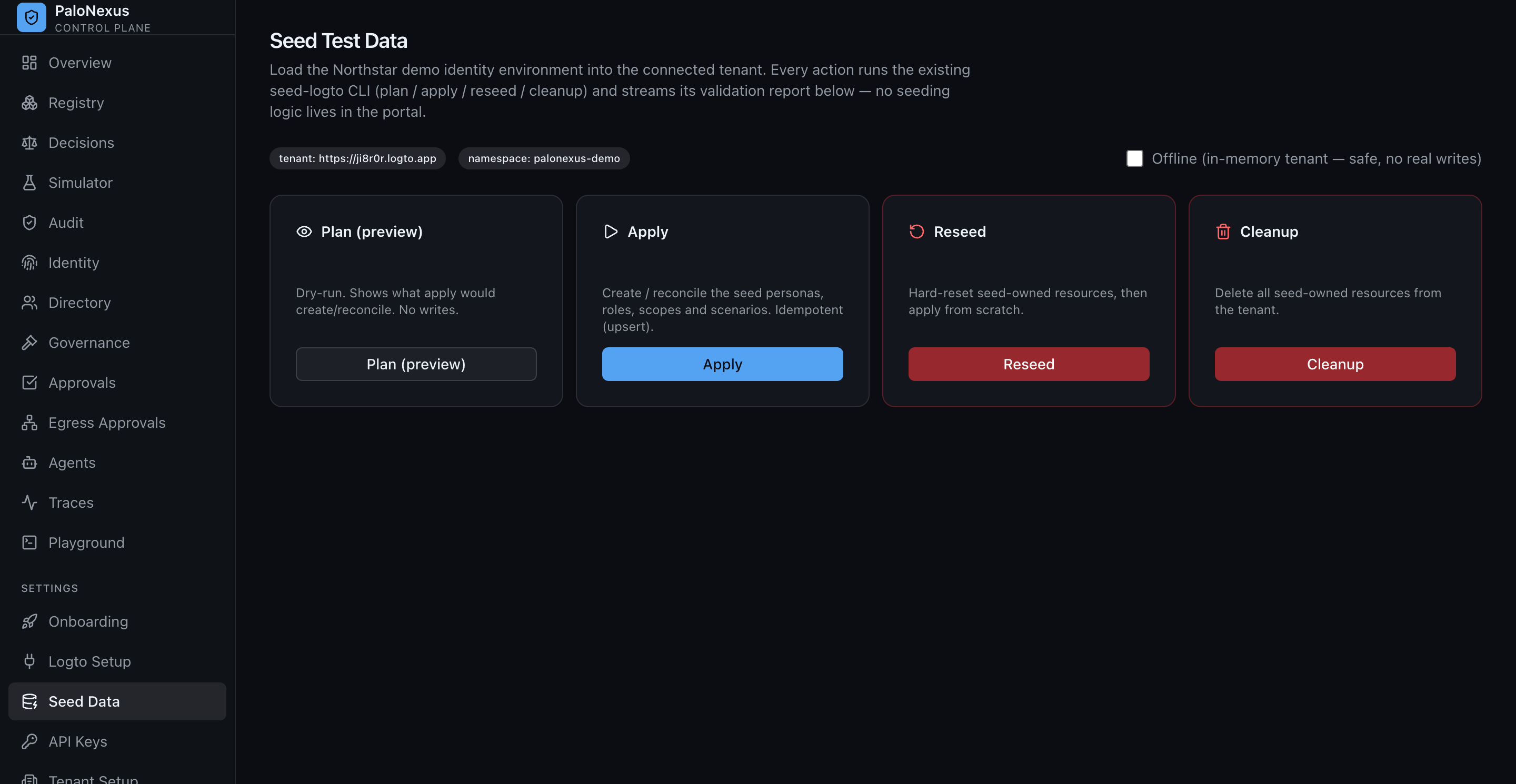
The /settings/seed console drives the seed-logto CLI against
the connected Logto tenant. Optional — only for loading the sample identity model.
Plan previews the upserts, Apply loads the sample identity environment,
and Reseed/Cleanup reset it — the same actions as Option B’s commands,
streamed back as a live report. The offline toggle dry-runs the seeder without a
live tenant.
Option B — from the CLI (no portal image dependency):
cd platform/seed-logtopython3 seed_logto.py check # safety preflight (exit 0 = OK)python3 seed_logto.py plan # preview the upsertspython3 seed_logto.py --no-dry-run apply # apply against the connected tenantUse --offline on any subcommand to dry-run the seeder with the in-memory
FakeLogtoClient (no live tenant) — useful for testing the path before real creds.
Step 5 — Deploy & register an authority-bound agent
Section titled “Step 5 — Deploy & register an authority-bound agent”Follow the deploy-langgraph-agent-to-palonexus skill (the canonical workflow).
Match the user’s ask to a phase; for a governed (egress-gated, HITL-capable)
agent on the selfhost overlay:
- Package the LangGraph
StateGraphas a FastAPI/uvicorn container with a persistent checkpointer (AsyncPostgresSavervia theagent-dbSecret) — HITL approval requires durable threads. Templates:platform/.claude/skills/deploy-langgraph-agent-to-palonexus/templates/. - Attach the egress middleware (
palonexus_middleware.py): it fetches the agent’s workload token, gates everywrap_tool_call/wrap_model_callthrough the egress/authzwithactor(agent) +subject(on-behalf-of) +task(thread id), and turns aneeds_human_approvaldecision into a LangGraphinterrupt(). It fails closed. - Manifests under
deploy/kustomize/base/agents/<agent-name>/— the default shape ships the egress-sidecar (modelbase_url→localhost:8788, sincelangchain_openaiwon’t honourHTTPS_PROXY), the shared identity emptyDir, the proxy env, and thepalonexus.io/agent: "true"label. Pair with theegress-enforcement+egress-sidecar+agent-admissioncomponents for the proxy-only NetworkPolicy + admission enforcement. - Register the agent, its tools, and the model-broker entries in the
registry (
templates/register-services.shagainst the mgmt API on:8181). Mark a sensitive tooldataClass: regulatedto force human-approved delegation via Rego. Registry mutations are themselves audited.
kubectl -n apps rollout status deploy/<agent-name> --timeout=180skubectl -n apps get pod -l app=<agent-name> # 2/2 Ready (agent + egress sidecar)The four sample site-reliability-engineering (SRE) agents (incident-triage, access-broker, diagnostics,
remediation) ship in the base and are a working reference — the
devops-incident sample scenario (agent northstar-devops-incident-agent, with a
seeded owner and a seeded sponsor/approver) is the one this runbook verifies below.
Step 6 — Verify a governed allow / deny / needs-approval
Section titled “Step 6 — Verify a governed allow / deny / needs-approval”Prove the decision spine end to end. The exact contract is in the skill’s verification checklist; the three decisions to demonstrate:
Allow — an in-allowlist model/tool call returns 200 with an egress.proxy
allow=true,reason=forwarded audit row (actor=<agent>):
# in-allowlist model call → 200, metered at the brokerkubectl -n apps logs deploy/<agent-name> -c agent | grep -i 'allow=true'Deny — a call to a model/tool/peer not in the agent’s egress allowlist is
denied (403) with an egress.proxy allow=false audit row, e.g.
reason: model "…" is not in <agent>'s egress allowlist. A direct provider call
must also fail the proxy-only NetworkPolicy.
Needs-approval (denied → approved) — a dataClass: regulated tool call
interrupts for human approval:
- The agent calls the regulated tool →
/authzreturns needs-approval; the middleware raises a LangGraphinterrupt()and a delegation request appears in the portal Authority Delegation surface. - An approver holding
org:agents:approveapproves; the console resumes the run viaCommand(resume=...). - The agent re-issues the call carrying the Delegation VC → allowed (200).
- The whole run is reconstructable from the hash-chained audit
(
actor=<agent>, subject=<user>, task=<thread>), trace-correlated in Tempo.
Confirm the audit chain is intact:
curl -s http://<mgmt>:8181/v1/audit/verify # chain verifies (tamper-evident)Optional — dry-run “what-if” without touching the agent
Section titled “Optional — dry-run “what-if” without touching the agent”If SIMULATE_OPERATOR_TOKEN is set on the control-plane, the policy simulator can
replay the same decision spine with no side effects (no enforcement audit, no
budget burn, no token mint):
curl -i http://<mgmt>:9191/authz \ -H 'X-Palonexus-Dry-Run: true' \ -H "X-Palonexus-Simulate-Operator: $SIMULATE_OPERATOR_TOKEN" \ -H 'X-Palonexus-Simulate-Subject: ethan.park@northstar.example' \ -H 'X-Palonexus-Simulate-Actor: northstar-devops-incident-agent' \ -H 'X-Palonexus-Action: runbooks:read' \ -H 'X-Palonexus-Resource: runbooks-api:/runbooks/db-failover'Empty token ⇒ the dry-run is disabled and fail-closed. Design-time eligibility
(who may own/sponsor/approve a scenario, before any agent is deployed) is the
separate POST /v1/authority/preview on agent-idp, which returns 503 if the
seed package isn’t mounted (SEED_LOGTO_DIR).
What can blow the 30-minute budget
Section titled “What can blow the 30-minute budget”Be explicit about the real-cluster risks; none are in the happy-path timings:
- Image build/push, not pull. The 30 minutes assumes images are already in a
pull-able registry. Building ten images from cold — especially cross-arch
(the DOKS nodes are amd64; an Apple-silicon laptop is arm64) — is an emulated
buildxbuild that can take far longer than the whole runbook. Pre-build on an amd64 host / CI, or pull pre-built tags. This is the single most likely overrun. - Bundled portal image for seed-from-UI. A plain
node:*portal imageENOENTs thepython3spawn; Step 4 Option A needs the Python-bundled image. Until that image is built+pushed, seed via the CLI (Option B). The live demo cluster’sportal:h10predates this — seedocs/requirements/ops-portal-deploy-note.mdfor the exact rollout. - LoadBalancer provisioning. A
type: LoadBalancerService (portal-public) can take a few minutes to get an external IP on DO; usekubectl port-forwardto stay inside the budget for the demo. - CRDs missing. If Gateway API CRDs / Envoy Gateway aren’t installed first
(Step 1), the Gateway/HTTPRoute/SecurityPolicy never program and
/authzis never on the path — every later step looks broken. - Stable issuer key. Without
agent-idp-issuer, agent-idp mints an ephemeral key; a restart invalidates every previously-issued VC mid-demo. - Container Network Interface (CNI) NetworkPolicy support. DOKS (Cilium) enforces NetworkPolicy, so the proxy-only egress lockdown is real — unlike kind’s default kindnet where it’s advisory. Good for fidelity; budget a moment to confirm the netpols applied.
Related
Section titled “Related”- Terraform / DOKS — provision the cluster + DOCR + VPC.
- Self-hosting — the overlay + opt-in hardening components.
- Secrets — the never-in-image secret catalog and External Secrets Operator (ESO)/sealed-secrets.
- Credential-safe action enforcement (ops) — the proxy, proxy-only netpols, admission webhook.
- The
deploy-langgraph-agent-to-palonexusskill — the agent-deployment workflow Step 5 reuses.