Connect Agents to Enterprise Authority
When an employee leaves, a manager changes, an owner moves teams, or a service’s ownership record changes, every piece of agent authority that person backed must die with it — automatically. That lifecycle-linked revocation is the headline of this layer: one directory change cascades into revoked delegations, quarantined orphaned agents, refused credentials, and a durable, reason-coded remediation log. Runtime and sandbox lifecycle is about containers; this lifecycle is about organizational authority.
PaloNexus runs alongside the workforce identity provider (IdP) — Logto is the supported IAM — it does not replace it. The IdP stays the source of truth for employees; PaloNexus is the agent identity, delegation, authorization, and audit layer that sits next to it and keeps agent authority tied to current human authority.
Division of ownership: the workforce IdP owns humans, PaloNexus owns agents
Section titled “Division of ownership: the workforce IdP owns humans, PaloNexus owns agents”The whole model rests on a clean split of responsibility. The workforce IdP owns humans
(Logto) — it is the IdP that holds employees and groups (kept current by SCIM, the System for Cross-domain Identity Management), the organization
roles people are assigned, the org:agents:* authority scopes those roles carry, and the
scenario API resources/scopes (runbooks:read, incidents:read, …). PaloNexus owns
agents — it issues each agent a cryptographic identity (did:key + a Membership Verifiable Credential (VC)),
records accountable ownership, classifies targets in its asset-type taxonomy, and mints the
task-scoped delegations that let an agent act. The bridge between the two halves is a
human: a delegation is only valid when the person granting it holds the matching authority
in the workforce IdP (Logto).
The diagram reads top-to-bottom on each side. On the left, SCIM populates the people that
org roles are assigned to, and those roles carry the org:agents:* scopes plus the API
scopes. On the right, PaloNexus’s agent identity, ownership, and delegations live entirely
inside the platform. The cross-edges are the load-bearing links: a human holds an org
role; that authority authorizes a delegation; the API scope the role carries maps to the
delegation’s task scope; agent ownership must resolve to an active SCIM employee; and the
delegation grants the agent its short-lived ability to act.
flowchart TB
  subgraph idp["Workforce IdP — owns HUMANS"]
    scim["SCIM users & groups"]
    org["Org roles<br/>org_devops_service_owner, org_agent_owner…"]
    scopes["org:agents:{own,sponsor,approve,operate,audit}"]
    api["API resources + scopes<br/>runbooks:read, incidents:read…"]
  end
  subgraph pnx["PaloNexus — owns AGENTS"]
    aid["Agent identity<br/>did:key + Membership VC"]
    own["Accountable ownership<br/>owner_ref, sponsor, risk_tier"]
    taxo["Asset-type taxonomy<br/>model · tool · agent · resource"]
    deleg["Task-scoped delegation (TBAC)"]
  end
  human(["Human owner / approver"])

  scim --> org --> scopes
  org --> api
  human -->|holds| org
  scopes -->|authorizes| deleg
  api -->|maps to task scope of| deleg
  own -->|must resolve to active employee| scim
  deleg -->|grants ability to act| aid
The workforce IdP (Logto) holds workforce identity, org roles, and the
org:agents:* and API scopes; PaloNexus holds agent identity, ownership, and delegations —
and a human’s authority is what authorizes each delegation.
Responsibility matrix
Section titled “Responsibility matrix”The split above, stated as a who-owns-what. The human/operator column is the accountable person acting through the consoles; they never own raw identity records — they exercise authority that Logto records and PaloNexus enforces.
| Concern | Workforce IdP / IAM | PaloNexus (agent authorization service) | Human / operator |
|---|---|---|---|
| Employee & group identity | Owns (SCIM source of truth) | Reads stable subject | — |
Workforce roles & org:agents:* scopes | Owns (assigns org roles) | Reads to evaluate authority | Is assigned a role |
API resource scopes (runbooks:read…) | Owns | Maps to delegation task scope | — |
Agent identity (did:key, Membership VC) | — | Owns (agent-idp issues) | — |
| Accountable agent ownership | Provides the employee it points to | Owns (owner_ref, sponsor, risk_tier) | Named as owner / sponsor |
| Task-scoped delegations (TBAC — task-based access control) | Provides the authority that justifies them | Owns (records, enforces, expires) | Requests / approves |
| Temporary elevation (approvals) | — | Owns the queue + Security Token Service (STS) exchange | Approves / denies |
| Audit trail | Logs its own admin events | Owns the hash-chained decision log | Reviews / verifies |
Logto is the supported workforce IdP. The “Workforce IdP / IAM” column describes the IdP’s role generically — architecturally, any OpenID Connect (OIDC) / SCIM-compliant IdP could fill it the same way through the standard surfaces. See the IdP support model below.
The problem federation doesn’t solve
Section titled “The problem federation doesn’t solve”Federation (OIDC / SAML) proves a sign-in. That is necessary but not sufficient for governing AI agents:
- A login token proves who signed in; it doesn’t keep joiner / mover / leaver state current. Someone can be deactivated in the directory and still hold a valid-looking token.
- Federation makes a human accountable; it says nothing about whether an agent has an accountable owner, or whether the human who authorized it still has the authority to do so.
- When authority disappears — an owner is disabled, an approver leaves, a group is removed — nothing automatically revokes what the agent was allowed to do.
PaloNexus closes that gap without becoming the IdP. SCIM directory sync is authoritative for lifecycle and organizational state; token claims are auth-time context only.
The two phases as one control loop
Section titled “The two phases as one control loop”The capability is delivered as two phases that compose into a single loop — the Phase-2 executive story:
A human owner authorizes an AI agent to perform a narrowly scoped task. PaloNexus verifies the human’s authority, records the delegation, and exchanges the agent’s proof and delegation evidence for a short-lived, audience-bound runtime credential. When the human loses authority or the agent loses valid ownership, PaloNexus automatically revokes the delegation, marks the related credentials revoked, quarantines the orphaned agent, and refuses to mint new tokens.
Phase 1 establishes durable identity and accountable ownership (directory sync → stable employee identity → agent ownership governance). Phase 2 turns that state into enforcement (revocation cascade → human-authority delegation → STS token exchange). The loop only holds because each link reads the same authoritative state: an employee deactivated by a SCIM sync immediately orphans their agents, invalidates the delegations they granted, and is refused by the token endpoint — all from one change.
The six building blocks
Section titled “The six building blocks”Each is a thin, composable piece with one load-bearing invariant. All of Phase 1 + Phase 2
ships in the agent-idp service.
F1 — Directory lifecycle sync
Section titled “F1 — Directory lifecycle sync”Ingests SCIM 2.0 Users and Groups (including the enterprise extension for manager and department) and reconciles a per-tenant snapshot into durable employee, group, and sync-run records. Joiner = create, mover = update, leaver = deactivate, rehire = reactivate the same record; re-sync is idempotent and tenant-isolated.
Invariant: the stable subject is
<idp>:<tenant_id>:<external_id>(e.g.entra:acme-corp:oid-1001) — never email — so an email change never forks a person.
F2 — Stable employee identity
Section titled “F2 — Stable employee identity”Distinguishes authentication claims (a login token) from durable enterprise identity
(SCIM). A resolver derives the stable subject from token claims (Entra ID iss/tid+oid,
Okta iss+sub) and applies explicit source-precedence; conflicts are surfaced, never
silently applied.
Invariant: SCIM is authoritative for status, manager, department, and durable groups. A token contributes non-authoritative session context only — a stale token can never reactivate a deactivated employee, and raw token roles never auto-promote to privileged PaloNexus roles.
F3 — Agent ownership governance
Section titled “F3 — Agent ownership governance”Replaces the registry’s free-form owner string with accountable, tenant-scoped
ownership: owner_ref, owner_type, team_ref, business_sponsor, risk_tier,
approved_runtime, status, created_by, last_reviewed_at. The owner must resolve to
an active employee or team from F2 in the same tenant. An activation gate refuses to
make an agent active unless it has a valid active owner, sponsor, risk tier, and approved
runtime.
Invariant: no agent may be orphaned — every authority-bound agent has an accountable owner, and owner-health is re-derived from the live directory.
F4 — Revocation cascade
Section titled “F4 — Revocation cascade”Turns F3’s detection into enforcement. When the owner, sponsor, approver, group, delegation, or agent state becomes invalid, the cascade suspends or quarantines the agent, revokes or invalidates its delegations, and marks the credential status revoked. It runs automatically at the end of every directory sync and on demand.
Invariant: every revocation is durable (an append-only log row, not a transient denial), reason-coded (
owner_inactive,group_removed,delegation_grantor_lost_authority, …), and idempotent — re-running the same event never double-revokes.
F5 — Human-authority delegation
Section titled “F5 — Human-authority delegation”Makes creating a delegation an authorization decision. The requester and approver must both be authenticated active employees in the agent’s tenant, and the approver must hold real authority over the resource or task before authority is granted. Authority is evaluated first-match across the bases below and the basis + evidence is recorded on the delegation.
Invariant: an approver must actually hold authority — owner / business sponsor / service owner / team owner / resource owner / manager chain / group / PaloNexus admin, or an explicit, prominently-logged
manual_break_glass. No authority → deny.
F6 — STS token exchange
Section titled “F6 — STS token exchange”An MVP Security Token Service that exchanges agent identity + delegation evidence + agent proof-of-possession into a short-lived, audience-bound JSON Web Token (JWT) — the short-lived runtime credential a normal resource server can consume. It validates fail-closed against every prior link — agent governance, delegation usability (the F4 cascade composes here), task/action/resource match, human actor status, audience, proof, and TTL.
Invariant: the token carries
sub=agent /act=human /cnf(proof-of-possession), a tight TTL, and is signed with the issuer’s Ed25519 key — and it is refused from a revoked, expired, or invalidated delegation.
Permission model: org roles → agent authority
Section titled “Permission model: org roles → agent authority”The org:agents:* scopes are the concrete authority an org role carries. The table below
maps the five roles of the devops-incident sample scenario (the incident-response
scenario these docs use throughout) to the scopes their seeded org roles at the sample
organization grant, exactly as the seed-logto fixture
assigns them. Read each row as “what
this person is allowed to do with agents”:
| Role | Seeded org role(s) | own | sponsor | approve | operate | audit |
|---|---|---|---|---|---|---|
| DevOps sponsor/approver | org_devops_service_owner, org_agent_owner, org_agent_sponsor, org_agent_approver | ✅ | ✅ | ✅ | — | — |
| DevOps agent owner | org_devops_service_owner, org_agent_owner, org_agent_operator | ✅ | — | ✅ | ✅ | — |
| DevOps operator | org_agent_operator | — | — | — | ✅ | — |
| Security triage owner/approver | org_agent_owner, org_agent_sponsor, org_agent_approver, org_agent_auditor | ✅ | ✅ | ✅ | — | ✅ |
| Negative-test employee | org_negative_test_employee | — | — | — | — | — |
Scope grants the ability; domain authority gates the use. Holding
org:agents:approvelets a role approve delegations in principle, but F5 still checks that the approver holds real authority over the specific resource or task. The DevOps agent owner can approve a DevOps incident delegation (as the DevOps service owner) but is denied approving a Finance reconciliation; the negative-test employee, with no agent authority at all, is denied every privileged action. That deny-by-default is the point of the negative persona.
Logto wiring. The
seed-logtofixture seeds this sample identity model into a Logto tenant for evaluation and testing; thelogto-m2mSecret, theLOGTO_*env vars, and the portal’s/settings/logtoconnector page below wire a deployment to its Logto tenant. See the IdP support model below.
Connect Logto and confirm exactly these credentials and the directory sync from the portal’s Logto connector page; secrets are validated server-side and never exposed to the browser:
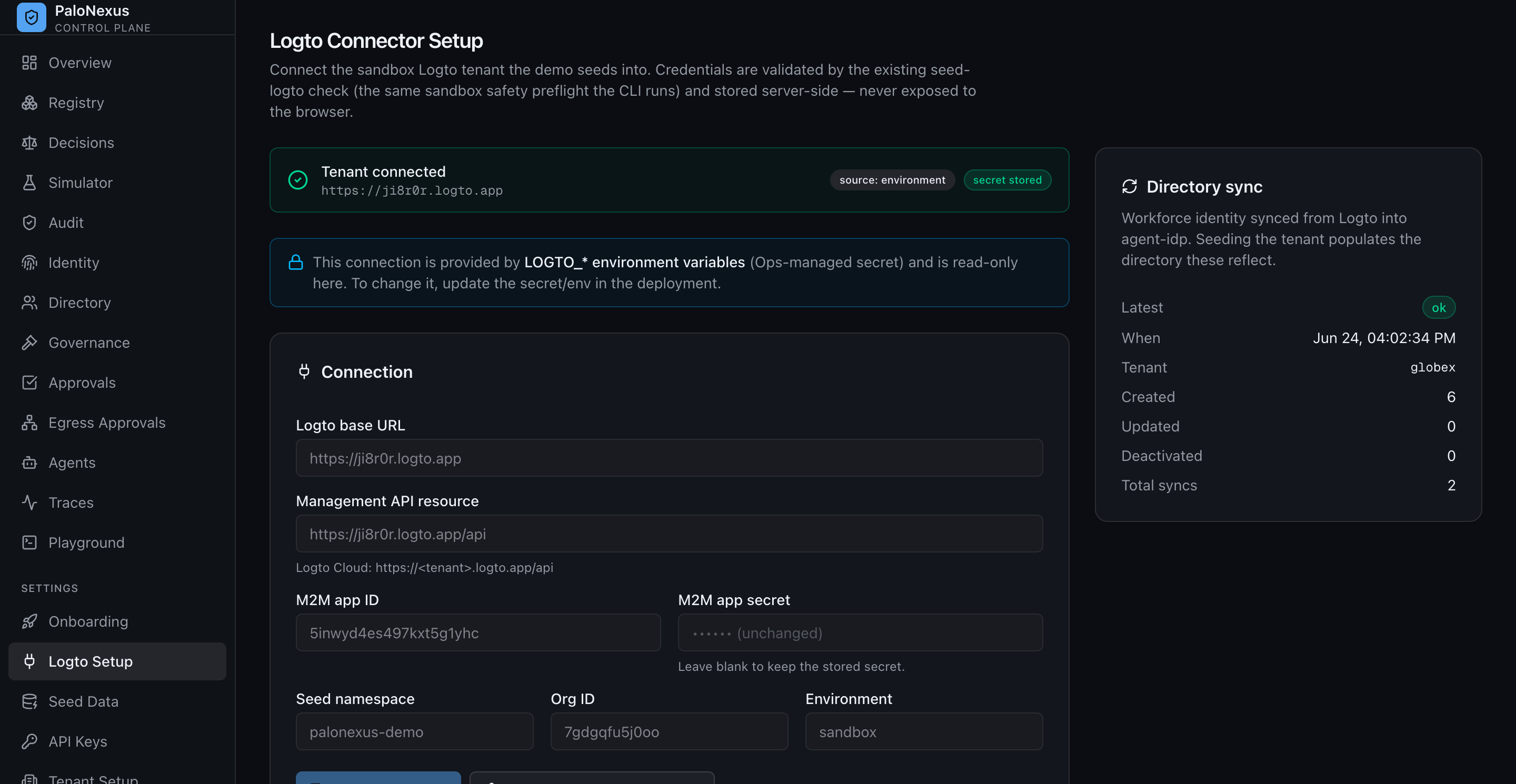
The portal’s Logto connector page validating a sandbox Logto tenant — see the IdP support model below.
IdP support model
Section titled “IdP support model”Logto is the supported workforce IAM. PaloNexus does not authenticate the workforce, store employee records, or replace the identity provider — it sits behind the existing workforce IAM and consumes it through open standards. The workforce IdP stays the source of truth for human identity (who works here, what groups and org roles they hold, and whether they are active); PaloNexus owns the layer the IdP has no concept of — AI agents, delegation, task authorization, temporary elevation, and a verifiable authority trail. As an architecture fact, the core is IdP-agnostic: any OIDC/SCIM-compliant IdP — Okta, Microsoft Entra ID, Auth0, Ping, Google Workspace, Amazon Cognito, Keycloak — could plug into exactly the same surfaces.
How an IdP connects
Section titled “How an IdP connects”The diagram reads left to right. The workforce IdP exposes standard surfaces — OIDC
sign-in plus a JSON Web Key Set (JWKS) endpoint, SCIM / directory sync (or API sync / webhooks) — and PaloNexus
consumes them to learn a stable employee subject, groups, org roles, and
lifecycle status. From that human authority, PaloNexus runs everything the IdP does not:
agent identity, human-authorized delegation, the /authz decision, time-boxed elevation, and
the audit chain. The IdP never learns about agents; PaloNexus never re-invents humans.
flowchart LR
  subgraph idpn["Workforce IdP / IAM (any OIDC + SCIM vendor)"]
    direction TB
    oidc["OIDC sign-in + JWKS"]
    scims["SCIM / directory sync<br/>API sync · webhooks"]
  end

  subgraph pnxn["PaloNexus — owns AGENTS"]
    direction TB
    agents["Agent identity<br/>did:key + VCs"]
    delegn["Delegation (TBAC)"]
    authz{"/authz decision"}
    elev["Temporary elevation"]
    audit[("Verifiable authority trail")]
  end

  oidc -->|"human sign-in keys (JWKS)"| authz
  scims -->|"stable subject, groups,<br/>org roles, lifecycle status"| delegn
  agents --> authz
  delegn --> authz
  authz --> elev --> authz
  authz --> audit
The workforce IdP supplies human identity through standard surfaces (OIDC/JWKS for sign-in,
SCIM/directory sync for lifecycle and org state); PaloNexus consumes that authority and owns
agents, delegation, the /authz decision, temporary elevation, and audit.
Three tiers: demo, supported, production
Section titled “Three tiers: demo, supported, production”“Which IdPs does PaloNexus support” has three honest answers. The demo tier is the seeded evaluation setup, so walkthroughs and seed data are reproducible; supported is Logto, the workforce IAM PaloNexus ships an end-to-end integration for; production is the organization’s own Logto tenant, wired via the same standard surfaces.
| Tier | What it means | Examples | How it’s wired | Status |
|---|---|---|---|---|
| Demo IdP | The Logto tenant the sample identity model is seeded into, so every walkthrough is reproducible — an evaluation and testing tool. | Logto (sandbox tenant) | seed-logto fixture, LOGTO_* env, the logto-m2m Secret, and the portal /settings/logto connector | Shipped (evaluation seed) |
| Supported IdP | Logto, supported end to end. Architecturally, any OIDC/SCIM-compliant IdP can supply human identity through the standard surfaces below. | Logto; Okta, Microsoft Entra ID, Auth0, Ping, Google Workspace, Amazon Cognito, Keycloak via standard surfaces | OIDC sign-in + JWKS (OIDC_ISSUER / OIDC_AUDIENCE / OIDC_JWKS_URL); SCIM / directory sync into agent-idp /v1/directory | Logto supported; otherwise standards-based (see honesty note) |
| Production customer IdP | The organization’s own workforce IdP, in its own tenant, kept as the source of truth. PaloNexus runs beside it and is configured to verify its tokens and consume its directory. | The organization’s Logto tenant | Point OIDC env at the tenant’s issuer/JWKS (the oidc component) + feed the directory into agent-idp — see Bring your own IdP | Bring-your-own via OIDC/SCIM |
Integration patterns
Section titled “Integration patterns”These are the standard surfaces PaloNexus consumes and the concrete seam each lands on. The seams are real: the platform verifies OIDC JWTs against JWKS today, and the agent-idp directory model is the workforce-sync integration point.
| Capability | Standard | PaloNexus seam | Notes |
|---|---|---|---|
| Human sign-in | OIDC + JWKS | OIDC_ISSUER / OIDC_AUDIENCE / OIDC_JWKS_URL — the control plane verifies each bearer JWT against the IdP’s JWKS | Auth-time context only; never the source of lifecycle truth |
| Workforce directory | SCIM 2.0 / directory sync / API sync / webhooks | agent-idp /v1/directory — ingests Users & Groups into durable per-tenant records | SCIM is authoritative for status, manager, department, durable groups |
| Stable employee subject | Durable subject claim | <idp>:<tenant_id>:<external_id> (e.g. entra:acme-corp:oid-1001) | The durable subject, not email — an email change never forks a person |
| Groups + org roles | Group / role membership | mapped to org:agents:{own,sponsor,approve,operate,audit} authority | Org roles carry the agent-authority scopes a human exercises |
| Lifecycle status | Joiner / mover / leaver | the revocation cascade (runs at end of every directory sync) | A deactivated employee orphans their agents and invalidates their delegations |
Evaluation seed setup (Logto)
Section titled “Evaluation seed setup (Logto)”The seed populates a Logto tenant with a reproducible sample identity model — an evaluation and testing tool, not a production requirement. These pages cover the seed:
- Environment variables — the
LOGTO_*seeder variable table. - DOKS runbook → Step 4: Seed the demo identity model — the
seed step (portal
/settings/seedbutton or theseed-logtoCLI). - Quickstart — the guided flows (a first authority-bound agent, plus the “Run the platform locally” tab).
A production deployment skips seed-logto/LOGTO_*/the logto-m2m Secret and
instead points the OIDC env vars at the production issuer and feeds the production
directory into agent-idp.
Honesty: standards vs. shipped connectors
Section titled “Honesty: standards vs. shipped connectors”To set expectations precisely:
- What is built and enforced today: OIDC JWT verification against JWKS
(
OIDC_ISSUER/OIDC_AUDIENCE/OIDC_JWKS_URL), and the agent-idp/v1/directorymodel that is the workforce-sync integration point. The supported IdP is Logto, wired through theseed-logtofixture and the portal connector. - What “supported” means: Logto ships with an end-to-end integration; other IdPs can integrate through the standard OIDC and SCIM/directory surfaces above. Where PaloNexus does not yet ship a vendor-specific, one-click connector (e.g. a turnkey Okta or Entra ID connector with branded setup UI), integration is via standard OIDC/SCIM rather than a pre-built vendor module. We say so plainly rather than imply connectors that are not shipped.
- Tracked for the backlog: vendor-specific connector packages, SAML sign-in (OIDC is the
verified path today), and broader directory-sync transports beyond SCIM are candidates
flagged for the backlog — see the repository
BACKLOG.mdand the Feature matrix.
Where it lives
Section titled “Where it lives”It is one FastAPI service, agent-idp — no new microservice was introduced; each
feature extends the existing identity pillar and reuses its pluggable persistence
(IDP_STORE_BACKEND: memory · sqlite · postgres · mysql · mongodb), so on a
durable backend the directory, governance, and revocation state survive restarts. Audit is
emitted as OpenTelemetry (OTel) spans (directory.sync, governance.transition, revocation.cascade,
delegation.authorize, sts.exchange) into the same observability and audit fabric the
rest of the platform uses.
In the operator portal it surfaces as two tabs:
- Directory — employees keyed by stable subject, groups, sync history, governance conflicts, and a sign-ins / token-precedence panel.
- Governance — authority-bound agents and their owners, delegations and authority evidence, the durable revocation log, and an interactive token-exchange (STS) panel.
Try it / see also
Section titled “Try it / see also”- Connect Agents to Enterprise Authority (how-to) — run the sync, ownership, delegation, and STS flows end to end.
- Enterprise IAM API — the exact request/response
shapes for
/v1/directory,/v1/governance,/v1/authority,/v1/revocation, and/v1/sts. - Agent identity & credentials — cryptographic agent identity plus the compliance and provenance governance credentials that build on this same ownership/activation model.
- Architecture → Consoles — the portal Directory and Governance walkthrough screenshots.
- Architecture — where IdP verification sits on the
/authzpath. - Feature matrix — shipped vs. optional vs. backlog.
- Authority delegation (how-to) — request, approve, and temporarily elevate, end to end.
Scope note
Section titled “Scope note”This is an MVP agent IAM authorization service, deliberately scoped to prove the
control loop. Deferred enterprise cases — full SCIM provisioning, an attribute-based access
control (ABAC) policy engine,
DPoP / mutual-TLS (mTLS) bound tokens, a JWKS endpoint and key rotation, multi-approver workflows,
token introspection / revocation lists, and more — are tracked in the repository
BACKLOG.md rather than silently omitted.