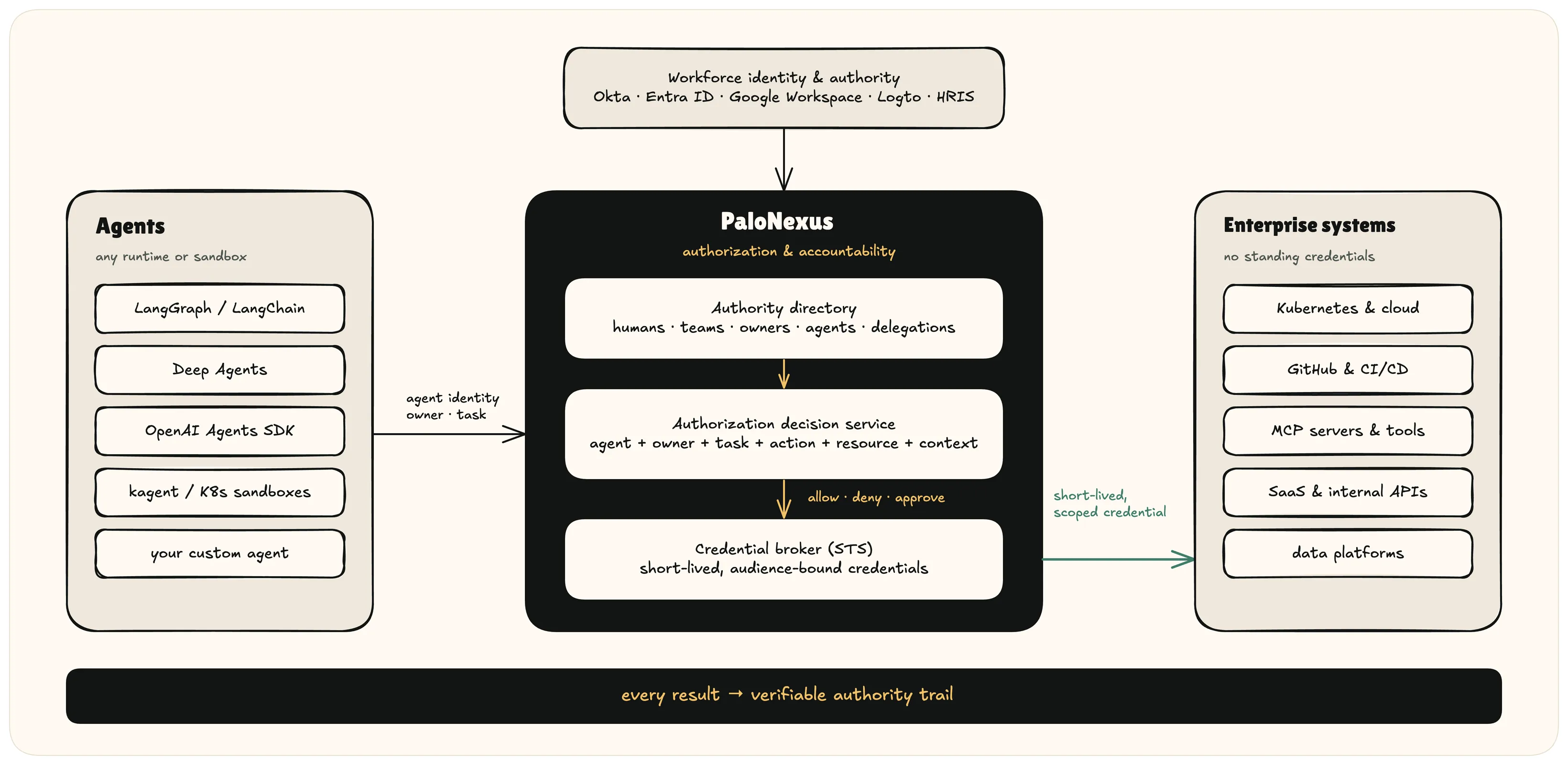
PaloNexus is an authorization and accountability service for AI-agent actions — the
identity governance layer between AI agents and the systems they act upon. It decides
authority, not routing: whenever an agent attempts an action — a model call, a tool
call, an agent→agent hop — one deny-by-default /authz decision answers may this agent
make this call, on behalf of this human, for this task, right now? Behind that answer sits
the authority graph: whose authority the agent is using,
whether that person was entitled to delegate it, and whether the delegation is still valid
at this moment.
Agent runtimes decide how an agent works.
Sandboxes decide where its code runs.
PaloNexus decides what it is authorized to do and whose authority it is using.
PaloNexus makes sure an AI agent can act only with authority that a real person or service owner was entitled to delegate—and only for the task, resource, and time originally approved.
PaloNexus is not an agent runtime and not a sandbox — it is the layer that governs
what either is allowed to do with real enterprise systems:
Layer
What it owns
Examples
Agent runtime
How an agent works — prompting, tool routing, memory, orchestration
LangChain, LangGraph, Deep Agents, OpenAI Agents SDK, kagent
Sandbox
Where its code runs — isolated filesystems, command execution, workspace lifecycle
Kubernetes Agent Sandbox, E2B, Daytona, Modal
PaloNexus
What it is authorized to do and whose authority it is using — accountable ownership, delegation, just-in-time credentials, revocation, authority trail
Works alongside all of the above
Keep the existing runtime and sandbox — PaloNexus complements both. See
What PaloNexus is not for the honest
category boundaries.
QuickstartTen minutes to a first authority-bound agent: register → denied by default → human-approved → succeed, fully offline. A second tab brings the whole platform up locally.
Temporary-elevation walkthroughThe end-to-end governed flow, on a sample incident: a production action is denied, an entitled owner grants a time-boxed elevation, the call succeeds on their behalf, and access expires automatically.
ReferenceThe code-accurate contracts in one place: Python SDK API, HTTP + Enterprise IAM APIs, CLI, environment variables, headers, feature matrix, and glossary.
An agent attempts an action — a model call, tool call, agent→agent hop, or API request.
The call reaches the deny-by-default /authz decision point — via an SDK guard, the
egress proxy, or Envoy’s external-authorization hook (ext_authz) at the gateway. There
is no path around it.
PaloNexus resolves the agent’s identity, its accountable owner, and the
on-behalf-of subject the task is bound to.
Policy evaluates the task, action, resource, allowlists, budgets, and any active
delegation. No valid authority means deny — or needs approval when a human
could grant it.
On needs-approval, a human whose entitlement is verified grants a time-boxed,
task-scoped delegation; the re-checked call passes on that approver’s behalf and the
access expires automatically.
The verdict — allow or deny, and every approval and expiry around it — lands on the
tamper-evident authority trail.
The same loop in one picture — the workforce identity provider (IdP) owns the humans, PaloNexus owns the
agents, and one decision connects them:
flowchart LR
    L[Workforce IdP<br/>owns humans<br/>Okta · Entra ID · Logto…] -->|owner + sponsor| P[PaloNexus<br/>owns agents]
    P -->|outbound call:<br/>deny-by-default| Z{authz}
    Z -->|needs approval| H[Human delegates<br/>task-scoped access]
    H -->|approve, time-boxed| E[Temporary elevation<br/>Delegation VC]
    E -->|allow, on-behalf-of| Z
    Z -->|every decision| A[(Audit<br/>proves control)]
The PaloNexus control loop: the workforce IdP — Logto is the supported IdP — owns
humans, PaloNexus owns agents, a human delegates task-scoped access, an approval turns a
denial into a time-boxed elevation, and every /authz decision is proven on the audit chain.
Any IdP speaking OpenID Connect (OIDC) and SCIM (System for Cross-domain Identity
Management) plugs in the same way — see
Connect agents to enterprise authority.
The same one authorization contract also gates inbound (north–south) requests entering the
gateway — may this caller reach this service? via Envoy ext_authz. That ingress
capability is the foundation egress governance is built on; the gateway, ingress, and
Kubernetes wiring behind it are deployment mechanics covered in
Self-host & operate.
PaloNexus is two complementary halves. Agents are built and integrated with the palonexus SDK —
a typed, framework-aware front door that wraps every model, tool, and agent-to-agent call an
agent makes, with typed deny/approve and an offline() mode for tests. The platform then
authorizes each of those calls at one deny-by-default /authz, drawing identity from
the workforce IdP (humans) and PaloNexus (agents). A denial becomes a time-boxed
elevation only when a human with the authority to approve it does — and every decision lands
on the authority trail.
Two halves of one system, with PaloNexus sitting between agents and the systems
they act upon. The SDK (①) is the build surface — a guard drops into LangChain, LangGraph,
or Deep Agents and the whole flow runs offline. The platform (②) is how every action is
authorized: the thick arrow is the single integration point — every outbound agent action
flows through /authz, which resolves the agent’s identity and its owner’s authority, asks
an entitled human to approve a time-boxed delegation when a regulated target needs one, and
records the verdict on the authority trail.
Working today: LangChain · LangGraph · Deep Agents · Logto as the workforce IdP,
speaking OpenID Connect (OIDC) and SCIM (System for Cross-domain Identity Management) ·
Kubernetes/Envoy
Planned: Okta · Entra ID · kagent · Kubernetes Agent Sandbox · OpenAI Agents SDK ·
Model Context Protocol (MCP)
See Integrations for the per-ecosystem pages, and the
Feature matrix for what ships today, what is opt-in, and
what is planned — tracked row by row.
Every production agent has an active accountable owner and an organizational sponsor.
Authority-bound delegation
An agent may receive only authority that an entitled human, group, or service owner is permitted to delegate.
Just-in-time access
No standing enterprise credentials. Access is issued for one task, target, action set, and short time window.
Lifecycle-linked revocation
Human and organizational changes cascade immediately into agent access and ownership state.
Verifiable authority trail
Every action can be traced from the agent to the task, delegation, approver, policy, runtime credential, and target outcome.
Network enforcement, signed credentials, Decentralized Identifiers (DIDs), Verifiable
Credentials (VCs), Open Policy Agent (OPA), Envoy, and
Kubernetes are implementation mechanisms beneath these pillars — they are how the
guarantees are enforced, not what the product is.
Beneath the pillars, six cooperating mechanisms — gateway, identity, registry, policy,
observability, audit — converge on the single /authz answer:
Mechanism
Role
Gateway
Envoy Gateway routes every request through /authz (SecurityPolicy.extAuth).
Identity
Humans via Dex (OIDC); agents via DID/VC (did:key subjects + a did:web issuer anchor).
Registry
The source of truth for services, agents, models, tools — plus egress allowlists and budgets.
Policy
Inline rules then an OPA (Rego) veto; deny-by-default, fail-closed.
Observability
Decisions, latency, per-agent token/cost as metrics; DID/VC spans as traces.
Audit
Every decision hash-chains to its predecessor — tamper-evident.
The security invariants behind every decision — deny-by-default, fail-closed on every
dependency, identity propagation (not token forwarding), and the tamper-evident authority
trail — are specified in the Security model; the
Kubernetes enforcement mechanics behind them are deployment detail in
Credential-safe action enforcement (Ops) and
Self-hosting.
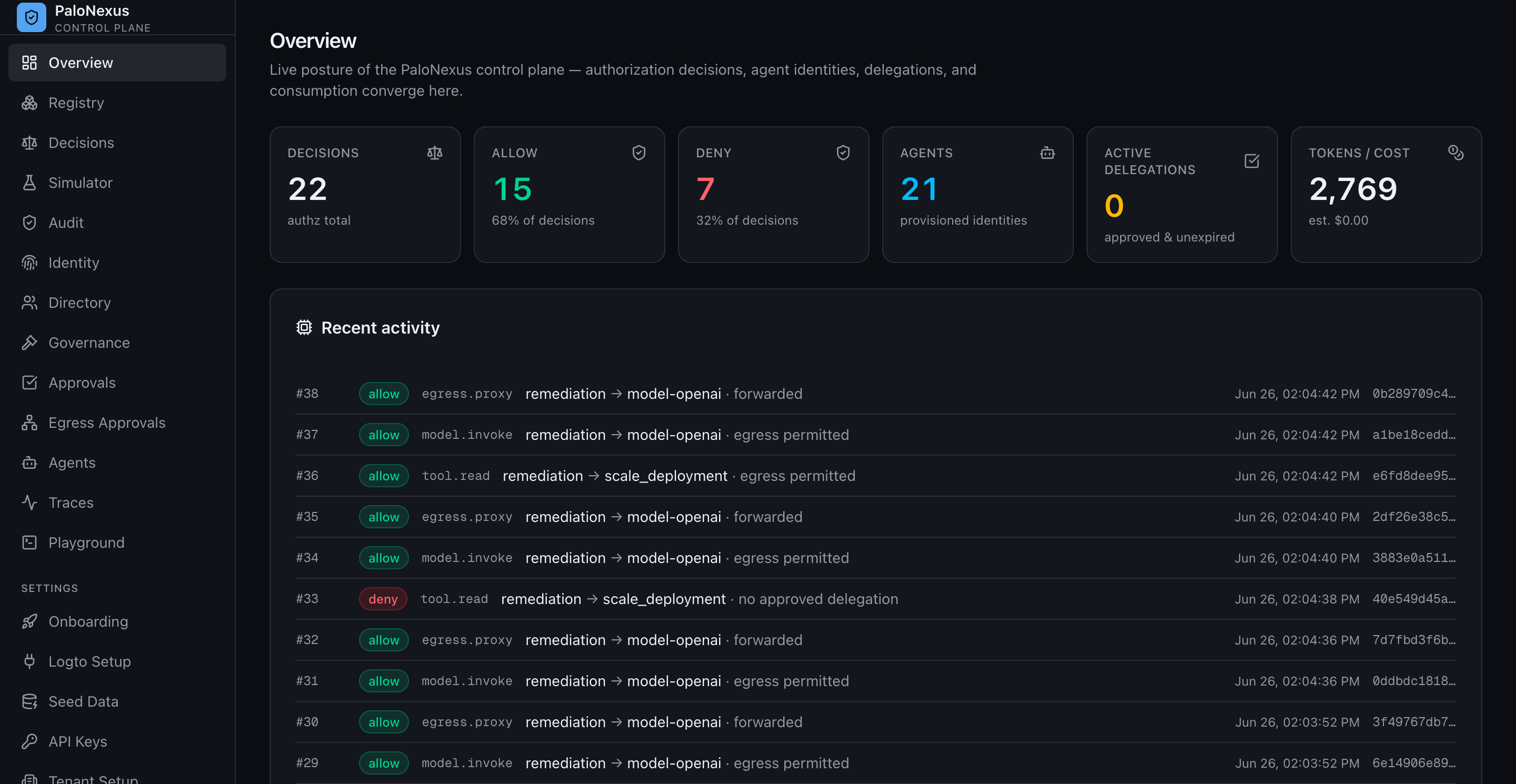
See it live on the operator console — authorization decisions, agent identities, active
delegations, and consumption in a single posture view:
Live posture of the PaloNexus authorization service: authorization decisions, agent identities,
delegations, and consumption in one view.