Deploy an Agent
This is the step-by-step path to running a LangChain/LangGraph agent as a governed
workload. Every step maps to a template in the
deploy-langgraph-agent-to-palonexus skill, which
ships the exact files referenced below.
1. Package the agent as a container
Section titled “1. Package the agent as a container”Default to a custom FastAPI/uvicorn container wrapping a compiled StateGraph:
lightweight, no LangSmith license, and easy to inject the egress middleware. (Use
the LangGraph Agent Server only when managed threads/durable runs are needed and a
LangSmith Enterprise license is held; its health endpoint is GET /ok on port 8000.)
Start from the skill’s templates/Dockerfile:
FROM python:3.12-slim AS baseENV PYTHONUNBUFFERED=1 PYTHONDONTWRITEBYTECODE=1 PIP_NO_CACHE_DIR=1WORKDIR /appCOPY requirements.txt .RUN pip install -r requirements.txt# requirements.txt pins: langgraph, langchain, langgraph-checkpoint-postgres,# fastapi, uvicorn[standard], httpx, opentelemetry-sdk, opentelemetry-exporter-otlpCOPY . .RUN useradd --uid 10001 --no-create-home --shell /usr/sbin/nologin appuserUSER 10001EXPOSE 8000# app:app must expose GET /readyz and GET /healthz, call checkpointer.setup() on# startup, and mount the palonexus egress middleware on the agent.CMD ["uvicorn", "app:app", "--host", "0.0.0.0", "--port", "8000"]docker build -t ghcr.io/palonexus/triage-agent:dev .2. The default fully-governed Deployment
Section titled “2. The default fully-governed Deployment”The skill’s templates/deployment.yaml is the default, fully-governed shape —
use it as-is. It ships four things that together make egress inescapable:
- the agent container,
- an egress-sidecar container (the agent’s model-egress endpoint),
- a shared
palonexus-identityemptyDir the agent writes its identity to and the sidecar reads, - the
palonexus.io/agent: "true"pod label that the admission webhook keys on.
apiVersion: apps/v1kind: Deploymentmetadata: name: triage-agent namespace: apps # agents live in the apps namespace labels: { app: triage-agent }spec: replicas: 2 selector: { matchLabels: { app: triage-agent } } template: metadata: labels: app: triage-agent palonexus.io/agent: "true" # admission webhook keys on this spec: securityContext: runAsNonRoot: true seccompProfile: { type: RuntimeDefault } volumes: - name: palonexus-identity # shared agent -> sidecar identity file emptyDir: {} containers: - name: agent image: ghcr.io/palonexus/triage-agent:dev ports: [{ name: http, containerPort: 8000 }] env: - { name: PALONEXUS_AGENT_NAME, value: "triage-agent" } - { name: PALONEXUS_EGRESS_URL, value: "http://egress.palonexus.svc.cluster.local" } - { name: PALONEXUS_TOKEN_PATH, value: "/var/run/secrets/palonexus/token" } # --- network-layer egress: route everything through the proxy / sidecar --- - { name: PALONEXUS_USE_EGRESS_SIDECAR, value: "1" } - { name: PALONEXUS_BROKER_URL, value: "http://localhost:8788" } # model calls -> sidecar - { name: PALONEXUS_IDENTITY_FILE, value: "/var/run/palonexus-identity/identity.json" } - { name: LANGCHAIN_OPENAI_TCP_KEEPALIVE, value: "0" } - { name: HTTPS_PROXY, value: "http://egress-proxy.palonexus.svc.cluster.local" } - { name: HTTP_PROXY, value: "http://egress-proxy.palonexus.svc.cluster.local" } - { name: NO_PROXY, value: "agent-idp.agent-idp.svc,egress.palonexus.svc,localhost,127.0.0.1,kubernetes.default.svc" } - { name: DATABASE_URI, valueFrom: { secretKeyRef: { name: triage-db, key: uri } } } # NOTE: no provider API keys here — model calls go via the broker. volumeMounts: - { name: palonexus-identity, mountPath: /var/run/palonexus-identity } securityContext: allowPrivilegeEscalation: false readOnlyRootFilesystem: true capabilities: { drop: ["ALL"] } readinessProbe: { httpGet: { path: /readyz, port: http } } # /ok for the Agent Server livenessProbe: { httpGet: { path: /healthz, port: http } } # --- egress identity sidecar: the agent's model-egress endpoint --- - name: egress-sidecar image: ghcr.io/palonexus/egress-sidecar:dev env: - { name: REAL_BROKER_URL, value: "http://model-broker.palonexus.svc.cluster.local:8080" } - { name: EGRESS_PROXY_URL, value: "http://egress-proxy.palonexus.svc.cluster.local" } - { name: PALONEXUS_IDENTITY_FILE, value: "/var/run/palonexus-identity/identity.json" } ports: [{ name: sidecar, containerPort: 8788 }] securityContext: runAsUser: 10002 runAsNonRoot: true allowPrivilegeEscalation: false capabilities: { drop: ["ALL"] } volumeMounts: - { name: palonexus-identity, mountPath: /var/run/palonexus-identity, readOnly: true } terminationGracePeriodSeconds: 120 # let in-flight runs checkpoint and drainThe same template includes the Service and the ingress HTTPRoute. The
HTTPRoute tags the registry service name the control plane resolves — identical to
the platform’s orders/echo sample routes from the quickstart:
apiVersion: gateway.networking.k8s.io/v1kind: HTTPRoutemetadata: { name: triage-agent, namespace: apps }spec: parentRefs: [{ name: edge, namespace: palonexus }] rules: - matches: [{ path: { type: PathPrefix, value: /agents/triage } }] filters: - type: RequestHeaderModifier requestHeaderModifier: set: [{ name: X-Palonexus-Service, value: triage-agent }] backendRefs: [{ name: triage-agent, port: 80 }]Why the sidecar plus HTTPS_PROXY rather than just one of them: LangChain’s OpenAI
client talks to its base_url and does not reliably honour the process proxy
env, so a ChatOpenAI call would silently escape /authz. Model calls go through
the sidecar (a base_url the client can’t strip); everything else goes through
HTTPS_PROXY; both land at the same /authz. Full rationale in
Credential-safe action enforcement.
3. The proxy-only NetworkPolicy
Section titled “3. The proxy-only NetworkPolicy”Without it, the sidecar and middleware are advisory. The skill’s
templates/networkpolicy.yaml is proxy-only egress lockdown — the enforcement
teeth. An agent pod may egress only to DNS, agent-idp (identity bootstrap, which
must bypass the proxy), the control-plane egress proxy, and its own checkpointer DB:
apiVersion: networking.k8s.io/v1kind: NetworkPolicymetadata: { name: triage-agent-egress, namespace: apps }spec: podSelector: { matchLabels: { app: triage-agent } } policyTypes: [Egress] egress: - to: [{ namespaceSelector: {}, podSelector: { matchLabels: { k8s-app: kube-dns } } }] ports: [{ protocol: UDP, port: 53 }, { protocol: TCP, port: 53 }] - to: [{ namespaceSelector: { matchLabels: { kubernetes.io/metadata.name: agent-idp } } }] ports: [{ protocol: TCP, port: 8090 }] # identity bootstrap (no VP yet) - to: [{ namespaceSelector: { matchLabels: { kubernetes.io/metadata.name: palonexus } } }] ports: [{ protocol: TCP, port: 80 }, { protocol: TCP, port: 9092 }] - to: [{ podSelector: { matchLabels: { app: triage-db } } }] ports: [{ protocol: TCP, port: 5432 }]For the four platform agents — the shipped site-reliability-engineering (SRE) sample
agents — prefer the egress-enforcement +
egress-sidecar + agent-admission Kustomize components over hand-rolling
these — they supply the proxy, flip each agent’s egress policy to proxy-only,
stamp the proxy env, and reject any palonexus.io/agent=true pod whose agent
isn’t registered + provisioned at the IdP (identity provider). See
self-hosting for the prerequisites (Gateway API
custom resource definitions (CRDs) + Envoy Gateway) and kubectl apply -k.
4. Register the agent and its egress allowlist
Section titled “4. Register the agent and its egress allowlist”Use the skill’s templates/register-services.sh (or, in prod, a GitOps reconciler
/ Agent CRDs). Register three kinds of entry against the mgmt API on :8181:
MGMT="${PALONEXUS_MGMT_URL:-http://localhost:8181}"reg() { curl -fsS -X POST "$MGMT/v1/registry/services" -H 'Content-Type: application/json' -d "$1"; }
# The agent itself. Callers must hold scope agent:triage:invoke. The Allow* lists# are its egress allowlist; budget caps token/call rate.reg '{  "name":"triage-agent","upstream":"triage-agent.apps.svc.cluster.local:80","owner":"sre",  "requireScope":"agent:triage:invoke","kind":"agent",  "allowModels":["model-openai"],"allowTools":["runbooks-api"],"allowAgents":[],  "budget":{"tokensPerHour":2000000,"callsPerHour":500}}'
# A tool it may reach.reg '{  "name":"runbooks-api","upstream":"runbooks.apps.svc.cluster.local:8080","owner":"sre",  "kind":"tool","dataClass":"internal"}'
# The model broker (holds the provider key; agents never do).reg '{  "name":"model-openai","upstream":"model-broker.palonexus.svc.cluster.local:8080",  "owner":"platform","kind":"model"}'
MayReach is deny-by-default: a target not on the matching Allow* list (or an
unknown kind) returns false. Registry mutations are themselves audited — expect a
registry.upsert record. Full schema and the Allow* / Budget semantics live in
Budgets and allowlists and the
HTTP API reference.
5. The model broker
Section titled “5. The model broker”The model broker is a thin LiteLLM proxy holding the real provider key (from a Secret) and metering every completion. Agents call it with a logical model name and get an OpenAI-compatible API; the broker maps the logical name to the real model id and attaches the key.
| Logical name (registry) | Real model | Use |
|---|---|---|
model-openai | openai/gpt-4o-mini | cheap default |
model-openai-large | openai/gpt-4o | stronger model |
The agent’s LLM client points at the broker (or, with the sidecar, at the localhost sidecar) and stamps the actor header:
ChatOpenAI(base_url=BROKER_URL, model="model-openai", api_key=BROKER_API_KEY, # never an OpenAI key default_headers={"x-palonexus-actor": AGENT_NAME})On each call: agent → egress proxy (/authz decides may <agent> reach
model-openai? via allowModels + budget) → broker maps model-openai →
openai/gpt-4o-mini, attaches the key → OpenAI → on success the broker POSTs
/v1/usage {agent, model, tokens, costUsd} to the control plane, feeding the
budget meter and the palonexus_token_usage_total / palonexus_agent_cost_usd_total
metrics.
Deploy the broker Secret out-of-band (it is gitignored) and register the broker:
cp deploy/kustomize/base/model-broker/secret.example.yaml \ deploy/kustomize/base/model-broker/secret.yaml # edit -> OPENAI_API_KEYkubectl apply -f deploy/kustomize/base/model-broker/secret.yamlPALONEXUS_MGMT_URL=http://localhost:8181 ./model-broker/register.sh6. Verify
Section titled “6. Verify”- Pod becomes Ready on its health probe; in-flight runs survive a rollout.
- Ingress: a call to the route with no/invalid token is denied; a valid token with the right scope is allowed (check the audit record).
- Egress allowlist: the agent cannot reach a model/tool/peer not in its
Allow*set (403+ anegress.proxyallow=falseaudit row + a metric). - NetworkPolicy: the pod cannot egress anywhere except the proxy
(
palonexus:9092) + agent-idp + DNS — a direct provider call must fail. - No provider API key exists in the pod spec or image.
curl -s localhost:8181/v1/audit?limit=10 # recent hash-chained recordscurl -s localhost:8181/v1/audit/verify # {"ok":true,"brokenAtSeq":-1}curl -s localhost:8181/metrics | grep palonexus_ # decisions, token usage, costOnce it is registered and provisioned, the agent appears in the Agent registry
(/agents) alongside every other governed workload:
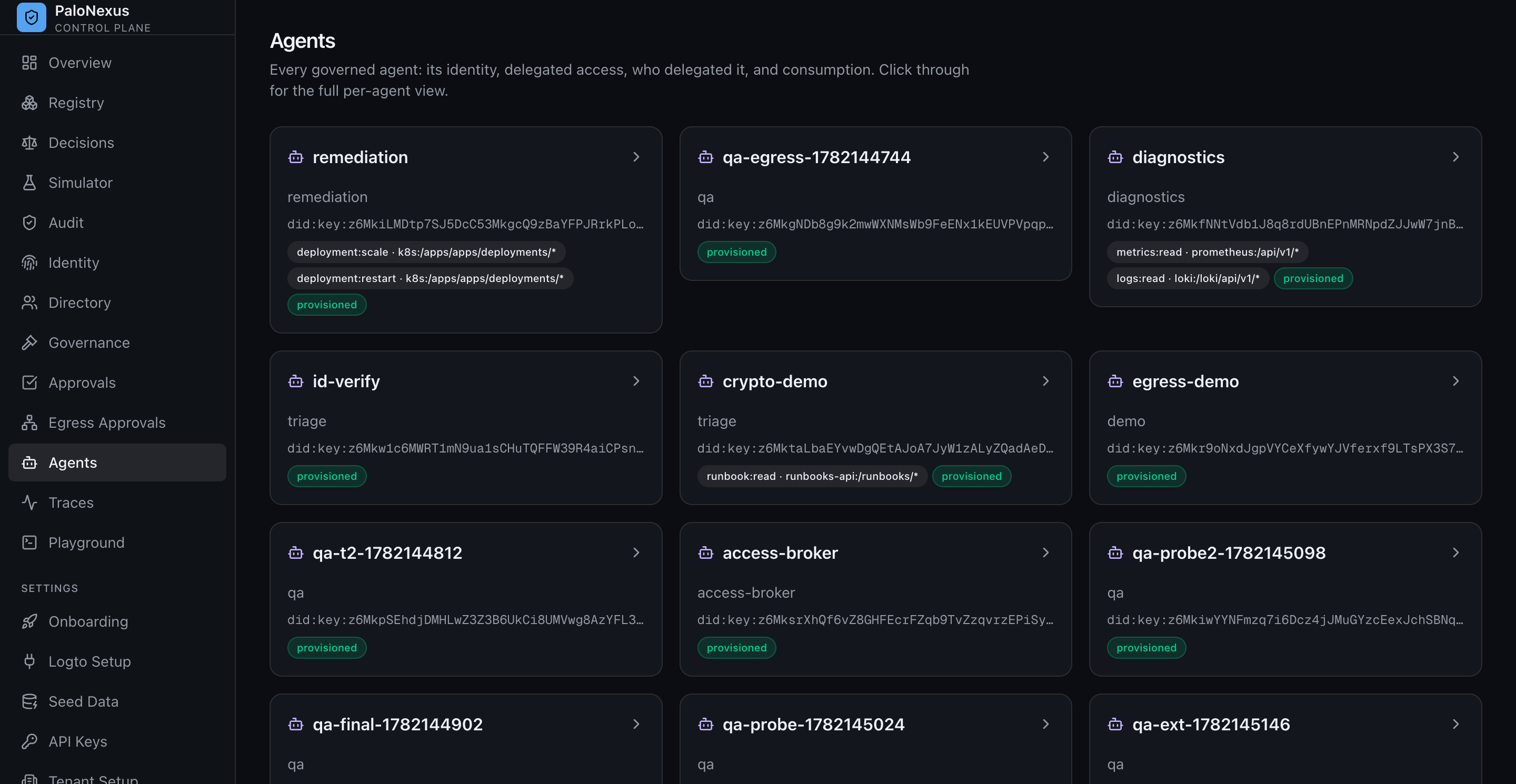
The /agents registry — every authority-bound agent with its identity (did:key),
delegated access and a provisioned status badge. A freshly deployed agent shows here
with its capabilities once register + provision succeed.
Next: Credential-safe action enforcement explains how each
outbound call actually traverses /authz.