Security model
This is the authoritative page for PaloNexus’s security posture — both the invariants the platform is built on and the scannable overview a security reviewer needs (trust boundaries, what is verified, data handling, disclosure, compliance posture). It states the invariants once and links out to the pages that show each in depth — it does not re-explain the egress plumbing (Credential-safe action enforcement), the credential crypto (Agent identity & credentials), or the deny-reason catalog (Troubleshooting).
The whole system reduces to one question, asked of every agent action:
May this agent make this outbound call, on behalf of this human, for this task, right now?
The same question gates ordinary inbound calls too (may this caller reach this service?) — that north-south capability is the foundation egress is built on, not the headline.
/authz answers it. Identity, registry, policy, audit,
and metrics converge there (internal/authz/authz.go); everything else is a dependency of that
one decision. PaloNexus is built deny-by-default and audit-by-construction: recording
the decision is the audit step in the same code path that makes it. And PaloNexus sits
beside the workforce identity provider (IdP), not in front of it: it never holds employee credentials,
and it acts on agent egress only when a human has delegated authority for a specific,
time-boxed task.
Trust boundaries
Section titled “Trust boundaries”Four trust zones meet at the control plane, and PaloNexus is explicit about what crosses each
boundary. The workforce IdP owns human identity and keeps the credentials. The PaloNexus control
plane makes the /authz decision and writes the tamper-evident audit. The agent-idp service is the
did:web issuer and the authority for delegations and revocations. The agents themselves are
confined by NetworkPolicy so their only route out is the egress proxy — there is no un-governed path
to a model, tool, or peer agent.
flowchart LR
  subgraph IdP["Workforce IdP — humans"]
    human["Employee<br/>holds the credentials"]
  end
  subgraph CP["PaloNexus control plane"]
    authz["/authz decision<br/>+ hash-chained audit"]
  end
  subgraph AIDP["agent-idp"]
    issuer["did:web issuer<br/>delegations + StatusList"]
  end
  subgraph Agents["Agent workloads — NetworkPolicy egress-only via proxy"]
    agent["Agent<br/>did:key holder"]
    proxy["Egress proxy"]
  end
  out["Model broker / tool / peer agent"]

  human -->|OIDC token in| authz
  agent -->|VP + delegation on egress| proxy
  proxy -->|same /authz decision| authz
  authz -->|verify VP and not-revoked| issuer
  authz -->|stamped subject + actor out| out
Trust boundaries: OpenID Connect (OIDC) tokens enter from the IdP, agent egress presents a Verifiable Presentation (VP) plus a delegation through the proxy, the control plane verifies identity against agent-idp, and only a trusted, stamped subject and actor cross to the target. Credentials never leave the IdP, and agents have no path out except the proxy.
What PaloNexus verifies
Section titled “What PaloNexus verifies”Every decision is the conjunction of these checks. Any one failing is a deny — and when a dependency can’t return a trustworthy yes, the decision fails closed rather than assuming allow.
| Surface | What is checked | Failure mode |
|---|---|---|
| Human token | OIDC JSON Web Token (JWT) validated against the IdP’s JSON Web Key Set (JWKS) (OIDC_ISSUER / OIDC_AUDIENCE / OIDC_JWKS_URL), required scope present verbatim | deny — missing/invalid token or scope |
| Agent identity | In vc mode, a fresh holder-signed Membership VP over audience + nonce, proven did:key mapped to the registered agent name | deny — verified agent credential required; actor-header mismatch denies |
| Delegation (TBAC) | A human-approved, time-boxed Delegation Verifiable Credential (VC) — task-based access control (TBAC) — scoped to (actor, task, action, resource) for regulated targets | deny / needs-approval — missing or expired delegation |
| Revocation | Membership and Delegation vcJti re-checked against the StatusList on every call | deny — CredentialRevoked, in under a second after revoke |
| Policy | Inline registry rules (public? scope? allowlisted? under budget?) then an Open Policy Agent (OPA) deny-overrides veto over org Rego | deny — inline or OPA deny; unreachable OPA fails closed |
| Budget | Per-agent rolling ceilings (calls/hour, tokens/hour, USD/day) from broker usage callbacks | deny — over budget |
| Audit chain | Each record hash-chains to its predecessor; /v1/audit/verify recomputes the chain | tamper detected — names the first broken sequence |
The four invariants
Section titled “The four invariants”1. Deny-by-default
Section titled “1. Deny-by-default”The default answer is no. Access is granted only by an explicit, current allow; the absence of a grant is a deny. Concretely, all of these deny:
- unknown service / unknown agent / unknown target (not in the registry);
- anonymous caller to a non-public service, or a token missing the verbatim
requireScope; - a target not on the calling agent’s egress allowlist;
- a
regulatedtarget with no valid, human-approved, task-scoped delegation; - an invalid, mismatched, expired, or revoked agent credential.
Every one of these emits a specific X-Palonexus-Deny-Reason;
in the SDK it surfaces as a typed exception, never a silent failure.
2. Fail-closed on every dependency
Section titled “2. Fail-closed on every dependency”When the decision point cannot get a trustworthy yes, it denies — it never assumes allow:
| Dependency unreachable | Behavior |
|---|---|
OPA (OPA_URL set but down) | deny — opa unavailable: … |
| agent-idp delegation check | deny — delegation authority unreachable: … |
| egress approval not decided in time | deny — egress approval expired (default 120s) |
| a durable DB backend misconfigured at startup | the process exits rather than silently falling back to in-memory (would lose registrations/delegations/revocations) |
| the control plane itself, from the SDK | raises ControlPlaneUnavailable — never a silent allow |
This is a deliberate design choice: an identity-and-access-management (IAM) product that “allows on error” is worse than none.
3. Policy is deny-overrides
Section titled “3. Policy is deny-overrides”Two layers decide, in order: fast inline rules from the registry entry (public? required scope? allowlisted? under budget?), then an optional OPA veto over org-wide Rego. An inline allow plus an OPA deny equals deny. OPA can veto; it can never rubber-stamp. This lets platform teams ship org policy (geo, time-of-day, data-class) without redeploying the control plane, and guarantees the stricter answer always wins.
4. Verifiable authority trail
Section titled “4. Verifiable authority trail”Every decision — allow or deny, ingress or egress — is recorded to a hash chain: each
record’s prev_hash equals the previous record’s hash. Editing or deleting any entry breaks
the chain, and pn.audit.verify_chain() (control-plane /v1/audit/verify) detects it. Audit is
by construction, not an afterthought: recording the decision is the audit step in the same
code path that makes it.
The diagram shows why tampering can’t hide. Each record hashes its own contents plus the
previous record’s hash into its prev_hash, so the records form an append-only chain. If
anyone edits or removes record n, its recomputed hash no longer matches the prev_hash
stored in record n+1; verify walks the chain recomputing each hash and reports the exact
sequence number where the first mismatch occurs.
flowchart LR
  r0["record n-1<br/>hash = H0"]
  r1["record n<br/>prev_hash = H0<br/>hash = H1"]
  r2["record n+1<br/>prev_hash = H1<br/>hash = H2"]
  r0 -->|prev_hash| r1 -->|prev_hash| r2
  verify[["/v1/audit/verify<br/>recompute every hash"]]
  verify -.->|first mismatch = tamper| r1
Each record links to its predecessor by hash; verify recomputes the chain and names the
sequence where it first breaks — so any edit or deletion is detectable.
In the portal, the Audit explorer exposes exactly this: the hash-chained log with a Verify chain button, per-event Tempo trace deep-links, and task/agent/scenario filters:
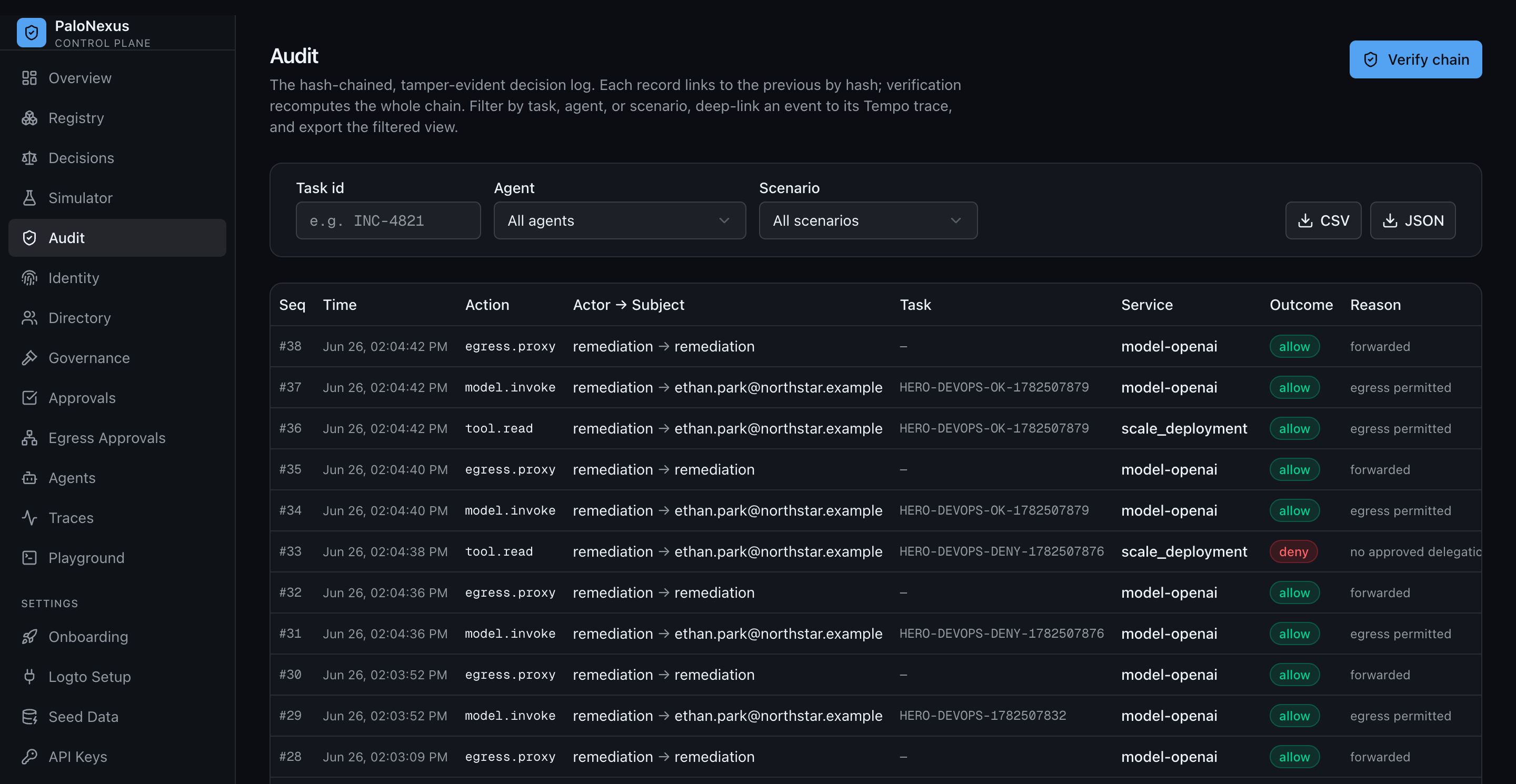
The Audit explorer: the tamper-evident, hash-chained decision log — filter it, deep-link any event to its Tempo trace, and verify the chain.
One decision for egress and ingress
Section titled “One decision for egress and ingress”The same /authz covers both directions, so there is no per-service auth code — just one
place to reason about access:
- Egress (the headline, and the hard part): every outbound action an agent takes — model call, tool call, agent-to-agent hop — passes the decision, carrying agent and on-behalf-of identity, answering may this agent make this outbound call, on behalf of this human, for this task, right now? Enforced at the network layer (forward proxy + NetworkPolicy + admission webhook), so it holds for any framework, not just cooperating SDK code. See Credential-safe action enforcement.
- Ingress (north-south):
client → gateway → /authz → upstream. Envoy’s external-authorization (ext_authz) filter routes every request through the same/authzbefore it reaches a service (the keystone,SecurityPolicy.extAuth). This is the foundation egress is built on, not the MVP headline.
A request is an agent egress call iff it carries an X-Palonexus-Actor header; otherwise it
takes the ingress path.
Identity propagation, not token forwarding
Section titled “Identity propagation, not token forwarding”On an allow, the control plane does not forward the caller’s raw token upstream. It verifies
the credential at the edge and stamps trusted headers — X-Palonexus-Subject (the human),
X-Palonexus-Actor (the agent), X-Palonexus-Agent-DID (the proven did:key),
X-Palonexus-Upstream — and upstreams trust the edge and never re-parse tokens. The target
service is named by X-Palonexus-Service (set by the HTTPRoute), falling back to Host.
For regulated work an agent never acts as itself: it acts on-behalf-of a human subject, and the audit records both actor and subject. Authorization is task-based (TBAC): a delegation is granted for one task (e.g. a single incident), time-boxed, and the agent does not retain the privilege afterward.
Cryptographic, revocable agent identity
Section titled “Cryptographic, revocable agent identity”Header-asserted actor identity is spoofable, so the production posture binds the actor to a Verifiable Credential:
- each agent holds a
did:keyprivate key + an issuer-signed Membership VC (fromagent.provision()); - on every egress call it presents a fresh, holder-signed VP over an audience + nonce;
- the control plane verifies it via agent-idp, maps the proven
did:keyto the registered agent name, and treats that as authoritative — theX-Palonexus-Actorheader, if present, must match or the call is denied; AGENT_IDENTITY_MODE=vcmakes a verified VP mandatory.
Revocation is enforced on the decision path, not advisory: verification re-checks the StatusList on every call, so revoking a credential denies the next decision in under a second — even mid-run. See the revocation race recipe. Full design in Agent identity & credentials.
How the SDK reflects the model
Section titled “How the SDK reflects the model”The SDK makes the posture a typed contract — deny-by-default surfaces as exceptions to handle, not status codes that are easy to forget to check:
| Platform behavior | SDK surface |
|---|---|
| hard deny (403) | PolicyDenied (carries the reason) |
| needs-approval (401 + needs-approval) | ApprovalRequired → drives request_delegation / interrupt() |
| delegation timed out | DelegationExpired |
| credential revoked mid-run | CredentialRevoked |
| decision point unreachable | ControlPlaneUnavailable (raised, never swallowed) |
| missing owner/sponsor at registration | GovernanceError (client-side, before any network call) |
Offline (PaloNexus.offline()), a FakeControlPlane mirrors the same deny-by-default semantics
so tests prove the contract with no cluster.
Data handling
Section titled “Data handling”PaloNexus stores the minimum needed to make and prove decisions. It does not store workforce passwords or credentials — those stay with the IdP. Secrets are never baked into images (see Secrets); they arrive at runtime from a secret manager.
| Data | Where | Sensitivity | Retention |
|---|---|---|---|
| Registry (services, agents, models, tools, allowlists, budgets, ownership) | control-plane store (REGISTRY_DB_URL) | Config / metadata — no end-user credentials | Operational; re-creatable from declarative source |
| agent-idp store (provisioned agents, delegations, revocations / StatusList) | agent-idp store (IDP_DB_URL) | Identity metadata; losing revocation state could resurrect a revoked credential | Operational; back up so revocation survives |
| Audit hash-chain | control-plane audit store → Loki / durable object storage | Decision system-of-record (metadata: actor, subject, target, outcome, reason, hash) — not payloads | Set to the applicable regulatory window; the long-term artifact |
| LangGraph checkpointer | PALONEXUS_AGENT_DB_URL | In-flight human-in-the-loop (HITL) thread state (paused approvals) | Operational; needed to resume paused runs |
| Issuer key | agent-idp Secret, from a secret manager | High — signs every VC and Security Token Service (STS) token | Must be stable; never rotated as part of a code upgrade |
| Workforce passwords / credentials | Not stored — held by the IdP | n/a | n/a |
The audit trail records decision metadata (who, on behalf of whom, against what target, the outcome and reason, and the chain hash) — it is not a content/payload store. See Persistence (operations) for what each store holds and Backups & restore for proving the audit chain survives intact.
Supported versions & hardening
Section titled “Supported versions & hardening”Production posture is opt-in and documented as a checklist. Turn the dev/demo overlay’s open
defaults into the strict settings with the Production hardening
checklist, and keep components within the supported set in the
Upgrades compatibility matrix
(control-plane / agent-idp / portal :h13, remediation :h12, model-broker :dev).
Production hardening at a glance:
- OIDC on — real human identity (
OIDC_ISSUER/OIDC_AUDIENCE/OIDC_JWKS_URL). AGENT_IDENTITY_MODE=vc— a verified Membership VP is mandatory; header-only egress denied.- OPA org veto —
OPA_URLset, deny-overrides, fails closed when unreachable. - NetworkPolicy egress-only-to-proxy — agents reach only DNS, agent-idp, and the proxy.
- Postgres-backed durable registry + agent-idp store (CloudNativePG — CNPG), so revocation survives restarts.
- Audit retention — ship the hash-chained audit to durable storage with a retention window.
- External Secrets — no secret in any image; deliver via External Secrets / sealed-secrets.
Responsible disclosure
Section titled “Responsible disclosure”Report a suspected security vulnerability in PaloNexus privately:
- Email:
security@palonexus.example(placeholder — confirm the real security contact before publishing this page externally). - Please do not open a public GitHub issue, discussion, or PR for a suspected vulnerability, and avoid posting proof-of-concept details publicly until a fix is available.
- Include the affected component and version (e.g.
control-plane :h13), reproduction steps, and impact. We aim to acknowledge reports and coordinate a fix and disclosure timeline with the reporter.
The full policy — supported components, scope (what’s in/out), expected handling, and a safe-harbor
statement — lives in the repository’s SECURITY.md at the repo root, and a machine-readable
contact is published as /.well-known/security.txt
(RFC 9116). Under this site’s /docs base that file serves
at /docs/.well-known/security.txt; the canonical site should also serve it at the domain root.
Compliance posture (honest)
Section titled “Compliance posture (honest)”PaloNexus is designed to support common control objectives that enterprise audits care about — least-privilege / just-in-time access, a complete and tamper-evident audit trail, separation of duties, and deny-by-default. It does not currently hold formal attestations (SOC 2, ISO 27001); those are roadmap, not current state. Where a control is designed-for rather than shipped, the table says so — it maps control objectives to how the platform supports them and the honest status.
| Control objective | How PaloNexus supports it | Status |
|---|---|---|
| Least privilege / just-in-time (JIT) access | Task-based access (TBAC): delegations are human-approved, time-boxed to one task, and not retained after | Shipped |
| Complete, tamper-evident audit trail | Every decision is a hash-chained record; /v1/audit/verify proves integrity | Shipped |
| Separation of duties | Agent ownership governance requires an accountable owner; delegation approval requires a human with real authority (owner ≠ approver, or logged break-glass) | Shipped |
| Deny-by-default / fail-closed | The default answer is deny; unreachable dependencies deny rather than allow | Shipped |
| Identity lifecycle (joiner/mover/leaver) | System for Cross-domain Identity Management (SCIM) directory sync + revocation cascade auto-suspends agents and invalidates delegations on a leaver | Shipped |
| Key management (issuer key) | Issuer key delivered out-of-band via a secret manager; KMS/HSM-backed key + automated rotation is on the roadmap | Partial |
| WORM / retention-locked audit sink | Audit ships to durable storage today; a retention-locked object store for WORM durability is on the roadmap | Partial |
| Formal attestation (SOC 2 / ISO 27001) | The control objectives above are designed-for; no certification is claimed | Roadmap — not attained |
Status terms match the Feature matrix: Shipped is built and verified live; Partial is shipped with a production-grade hardening upgrade still open; the formal attestations are explicitly not claimed.
Related
Section titled “Related”- Credential-safe action enforcement — the network-layer enforcement design.
- Agent identity & credentials — VCs, identity modes, revocation.
- Troubleshooting — every
X-Palonexus-Deny-Reason, decoded. - Production hardening — turning each invariant on for production.
- Secrets — the never-in-image rule and External Secrets.
- Backups & restore — proving the audit chain survives intact.
- Observability — where the audit chain and metrics ship.
- Feature matrix — every capability, with Shipped/Partial/Planned status.
- Glossary — every term used above.