Agent identity & credentials
When an agent acts, an enterprise must be able to prove which agent acted, whose authority it used, whether that authority was still valid, and why the action was allowed — and that proof has to be unforgeable by any workload that can set an HTTP header, go away the instant the authority behind it is revoked, and (for a downstream consumer of the agent’s output — a regulator, an auditor, a partner enterprise) answer one question more: what does this agent attest about itself, and can I check that attestation without trusting PaloNexus’s live API?
The credential machinery behind those proofs includes cryptographic egress identity, revocation on the decision path, the durable human identity behind every agent, and compliance and provenance governance credentials. Throughout, DID/VC — Decentralized Identifiers (DIDs) and Verifiable Credentials (VCs) — is one supported credential format — the mechanism PaloNexus uses to make signed agent credentials and proof of authorization independently verifiable, not the product category. All of it is shipped and verified live on a managed Kubernetes cluster (DigitalOcean Kubernetes — DOKS — example); the durable storage underneath is covered in Persistence (operations).
Cryptographic egress identity
Section titled “Cryptographic egress identity”The problem. Egress identified the calling agent by the X-Palonexus-Actor
header, which any pod in apps can set. NetworkPolicy + registry + policy still
enforced, but the identity was spoofable.
The design — bind the actor to a Verifiable Credential. Each agent holds a
did:key private key and an issuer-signed Membership VC (from agent-idp
provisioning). On every egress call the middleware presents a Verifiable
Presentation (VP): the Membership VC wrapped with a fresh holder signature over an
audience (palonexus-egress) and a nonce, in the X-Palonexus-Agent-VP header (or
as Proxy-Authorization at the egress proxy).
Because the crypto lives in agentdid (Python) and the control plane is Go,
verification reuses the control-plane → agent-idp over HTTP pattern: a fail-closed
internal/agentid client calls POST /v1/agents/verify-presentation, which:
- verifies the holder
did:keysignature on the VP, the audience, and the nonce; - finds the issuer-signed Membership VC inside it, verifies it chains to the
did:webissuer for this holder and is not revoked (the StatusList); and - maps the proven
did:keyback to the registered agent name.
The control plane derives the actor from that proven, registry-bound result — the header name, if present, must match it or the call is denied.
Identity modes — AGENT_IDENTITY_MODE
Section titled “Identity modes — AGENT_IDENTITY_MODE”| Mode | Behavior |
|---|---|
header (default, demo / back-compat) | trust X-Palonexus-Actor; verify a VP if one is present (defense in depth) but don’t require it |
vc (production) | a verified X-Palonexus-Agent-VP is required; a missing/invalid VP, or an actor-name mismatch, denies |
In vc mode, header-only egress is denied by design — flip back to header for a
narrated header-only demo.
Revocation enforced at /authz
Section titled “Revocation enforced at /authz”Revocation is not advisory — it is enforced on the decision path. The Membership VC
and every Delegation VC carry a vcJti; agent-idp keeps a StatusList of revoked
JTIs (GET /status/{list}). Revoking a JTI (POST /v1/revoke) means the next
/authz (or egress-proxy) call that depends on it denies, because verification
re-checks the StatusList every time. This powers the live-revocation race demo:
revoke a VC in the portal and the next decision denies in under a second.
This makes agent identity cryptographic and revocable end-to-end, while delegation / task-based access control (TBAC) for regulated targets layers on top exactly as before.
Durable identity: SCIM directory sync
Section titled “Durable identity: SCIM directory sync”Cryptographic agent identity only stays trustworthy if the human identity behind it is current. That is what the agent-idp directory sync persists: the enterprise identity provider (IdP) pushes its workforce over SCIM 2.0 (the System for Cross-domain Identity Management), agent-idp reconciles it into the same durable store, and the result is a stable subject that survives email changes, re-syncs, and pod restarts.
The sequence below shows one sync. The IdP sends a Users + Groups snapshot to
/v1/directory/sync; agent-idp derives the stable subject idp:tenant:external_id
(never email, so changing an address never forks a person), reconciles employee, group,
and sync-run records into the durable backend, and re-derives owner/sponsor validity for
governance. The lower half is the lifecycle teeth: when the same sync reports a leaver,
agent-idp deactivates that one record and fires the revocation cascade, which quarantines the
person’s agents, invalidates their delegations, and marks the dependent credentials revoked —
all from a single directory change.
sequenceDiagram
  participant IdP as Enterprise IdP (SCIM 2.0)
  participant AIDP as agent-idp /v1/directory/sync
  participant Store as Durable store
  participant Gov as Governance (owner/sponsor)
  participant Casc as Revocation cascade

  IdP->>AIDP: Users + Groups snapshot
  AIDP->>AIDP: derive stable subject<br/>idp:tenant:external_id (never email)
  AIDP->>Store: reconcile employee / group / sync-run
  AIDP->>Gov: re-derive owner + sponsor validity
  Note over IdP,AIDP: leaver = deactivate the same record
  IdP-->>AIDP: employee deactivated
  AIDP->>Casc: trigger cascade
  Casc->>Store: quarantine agents, invalidate delegations, revoke credentials
One SCIM sync: the stable subject is reconciled into durable storage, and a leaver in the same snapshot triggers the revocation cascade — joiner/mover/leaver state stays accountable.
The portal’s Directory tab is the read-out of this durable state — employees keyed by stable subject, the SCIM sync history, and a sign-in precedence panel that flags stale and group-conflict tokens:
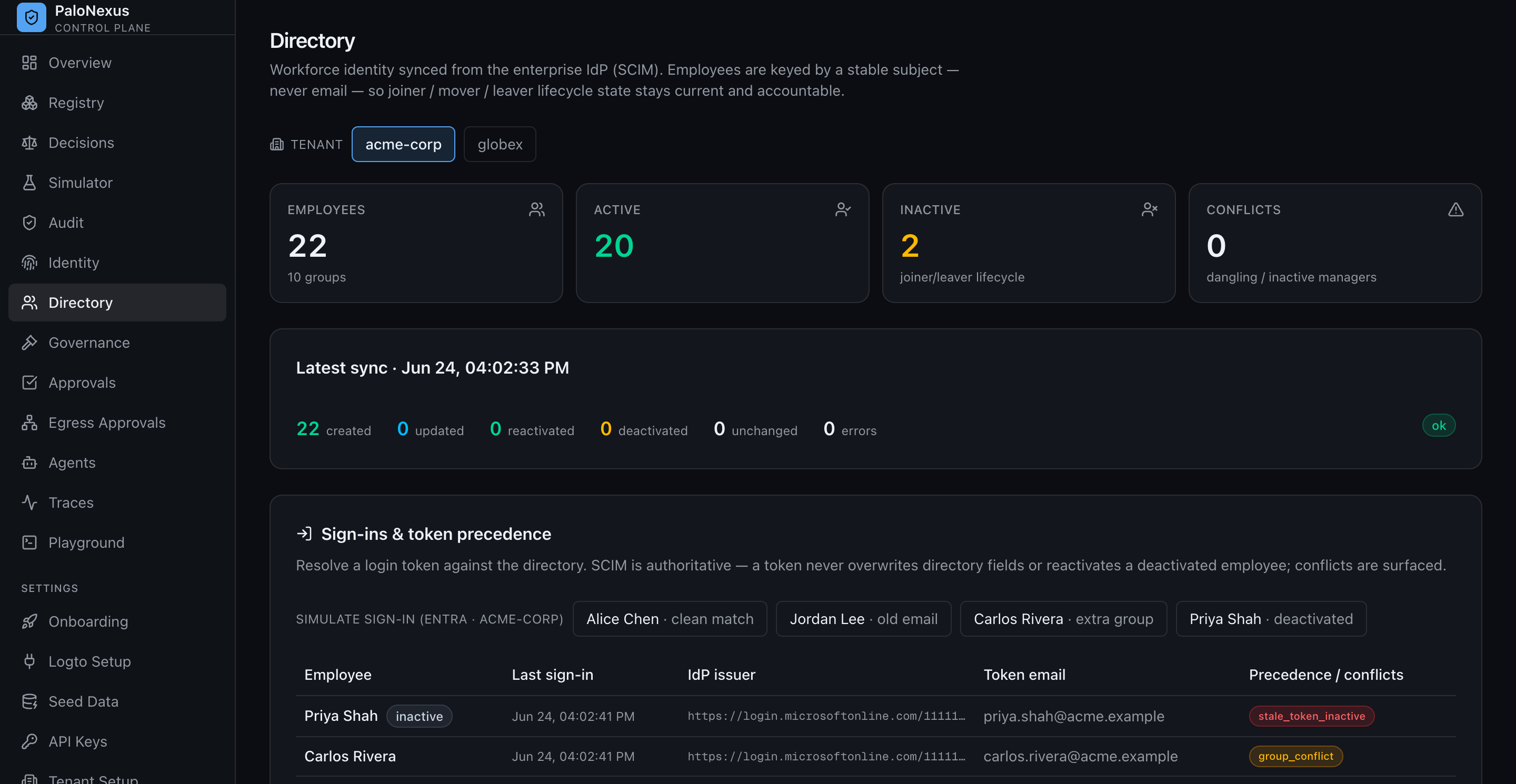
The Directory console: workforce identity synced from the enterprise IdP via SCIM, keyed by stable subject so joiner/mover/leaver state stays accountable.
The Identity tab pivots to the agent side of the same persisted state — the did:web
issuer trust anchor, the agents it has provisioned with their did:key identifiers, and the
task-scoped delegations (and revocations) that grant them access:
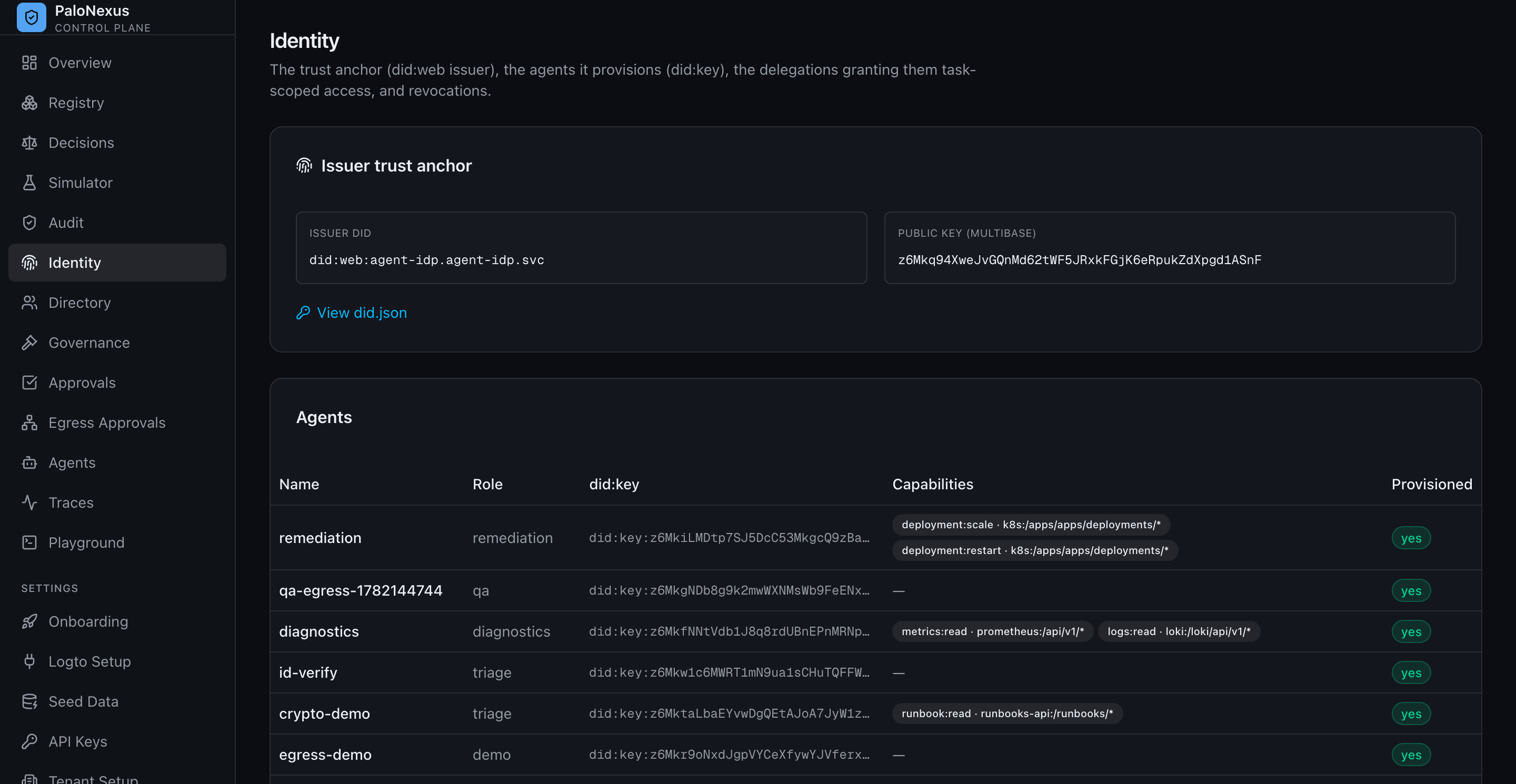
The Identity console: the trust anchor, the agents it provisions, and the task-scoped delegations granting (and revoking) access — the cryptographic identity described above, made visible.
Governance credentials: compliance & provenance
Section titled “Governance credentials: compliance & provenance”Agent ownership and delegation (the six building blocks) answer the authority part — is this agent allowed to act. Two more credential types answer the disclosure part:
- Compliance credential — “this agent’s operation meets standard X” (GDPR, HIPAA, SOC2-TypeII, EU AI Act Art. 50), attested by a third-party auditor.
- Provenance credential — “this agent’s outputs came from base model X, trained on Y, under declared owner Z,” self-declared by whoever operates the agent.
Both are real, signed agentdid JWT-VCs — VCs serialized as JSON Web Tokens (JWTs) —
anchored to the issuer’s did:web document — not
JSON rows a caller has to trust agent-idp’s live API to report honestly.
The gap this closes
Section titled “The gap this closes”Every identity credential PaloNexus issues for agent authority — Membership and Delegation
VCs (see the Glossary) — was a real, Ed25519-signed JWT-VC
from day one, independently verifiable by resolving the issuer’s did:web document over
HTTPS. The compliance credential did not start that way: it shipped as a plain JSON row with
no signature, so a party checking an agent’s compliance posture had no choice but to trust
agent-idp’s live API response. That gap is closed — compliance credentials are now signed the
same way membership and delegation credentials always were, and provenance credentials (a new
credential type) were built on that corrected foundation from their first line of code.
What “cryptographically verifiable” actually means here
Section titled “What “cryptographically verifiable” actually means here”It means: the credential was signed by the claimed issuer, it hasn’t been revoked, and it
hasn’t been tampered with since issuance — checkable by anyone who can resolve the issuer’s
did:web document, with zero calls to agent-idp’s live API.
It does not mean: the claim inside the credential is true. There is no watermark detection, no training-data audit, no independent compliance audit performed by PaloNexus. Both credential types are self-attested exactly the way an SOC2 report or a signed vendor attestation is self-attested elsewhere in enterprise trust — the value is a durable, verifiable, revocable attribution record, not proof of the underlying technical or regulatory claim. State this caveat plainly to anyone evaluating these credentials; it is not a footnote.
Compliance credentials
Section titled “Compliance credentials”A named-standard attestation about an agent, issued by an accountable human holding the
compliance_auditor role. Query is public; issuance requires the role. Revocation does
not currently check the role — a known, tracked gap (unlike provenance credentials below,
where revoke does check it).
| Field | Meaning |
|---|---|
standard | e.g. GDPR, HIPAA, SOC2-TypeII, EU-AI-Act-Art50 |
scope | free-text scope of the attestation, e.g. "PII access during containment actions" |
evidence_ref | pointer to the audit evidence — not the document itself |
expires_at | optional; an expired credential is treated as absent |
status | valid | revoked | expired (expiry is wall-clock derived, not a stored transition) |
Wired into agent governance two ways:
- Activation gate. An authority-bound agent’s
required_compliance_standardsblocks it from reachingactiveuntil every listed standard has a valid, unexpired credential. - Revocation cascade. A required credential that expires or is explicitly revoked
suspends the agent with a dedicated reason code (
compliance_credential_expired/compliance_credential_revoked) through the same cascade that handles an owner going inactive — see Enterprise IAM.
Provenance credentials
Section titled “Provenance credentials”A self-declared attestation of what produced an agent’s outputs: base model, model version,
training-data lineage, declared model owner. Issued by a distinct provenance_attestor
role — deliberately not overloaded onto compliance_auditor or the agent’s governance owner,
since the person who knows an agent’s model lineage is often not its compliance auditor or its
business owner.
| Field | Meaning |
|---|---|
base_model | e.g. "claude-sonnet-5", "gpt-5.4", "internal-finetune-v3" |
model_version | a specific snapshot/build identifier, if known |
training_data_sources | free-text refs — not independently verified |
watermarking_scheme | e.g. "PDW", "none declared" — self-attested |
declared_owner | the entity accountable for the base model, e.g. "Anthropic" |
evidence_ref | pointer to a model card / internal doc backing the declaration |
status | valid | superseded | revoked |
Supersession, not just revocation. An agent’s provenance legitimately changes — a base
model upgrade, a training-data refresh. Issuing a new provenance credential for an agent that
already has one automatically marks the prior one superseded (superseded_by set to the
new credential’s id). Supersession is a routine, non-cascading store update: it never writes
a revocation-log row and never suspends the agent. Only an explicit revoke — a declared
base model turning out to be false, for example — feeds the revocation cascade, with a
dedicated reason code (provenance_credential_revoked).
An authority-bound agent can require one the same way it can require a compliance standard: set
require_provenance_credential: true and activation blocks until a current (valid,
non-superseded, non-revoked) credential exists.
Disclosure: both credentials, one artifact
Section titled “Disclosure: both credentials, one artifact”GET /v1/agents/{agent_id}/disclosure assembles an agent’s current compliance credentials
and current provenance credential into one machine-readable object — the EU AI Act Art.
50-shaped answer to “what is this agent, who backs it, and is it compliant,” in one call. See
the exact response shape in the Enterprise IAM API reference.
How the cryptography actually works — no blockchain
Section titled “How the cryptography actually works — no blockchain”flowchart LR issuer["agent-idp Issuer<br/>did:web trust anchor<br/>Ed25519 keypair"] vc["Signed JWT-VC<br/>ComplianceCredential /<br/>ProvenanceCredential"] doc["/.well-known/did.json<br/>current key + key history"] status["/status/default<br/>StatusList2021"] verifier["Third-party verifier<br/>auditor, partner, air-gapped enforcement point"] issuer -->|signs| vc issuer -->|serves| doc issuer -->|serves| status vc -->|1. resolve issuer key by kid| verifier doc -->|2. fetch over HTTPS| verifier status -->|3. check not revoked| verifier verifier -->|verify signature + status, zero PaloNexus API calls| vc
Three pieces, all pre-existing in PaloNexus’s identity stack and reused rather than reinvented for these two credential types:
did:webas the trust root. The issuer’s public key lives at a resolvable/.well-known/did.json, the same anchor Membership and Delegation VCs already use. No wallet, no gas fee, no chain-sync latency — the trade-off is that trust is anchored in DNS- TLS + whoever controls the issuer’s domain, the same model enterprise PKI already runs on.
- StatusList2021 revocation, the same endpoint (
GET /status/{list_id}) delegation VCs already serve. Revoking a compliance or provenance credential flips its position in the same list a verifier already knows how to check — no new revocation mechanism to learn. - Issuer key history.
GET /v1/issuer/key-historylists the issuer’s current and prior (superseded) signing keys, so a credential signed before a key rotation still verifies — the DID document lists every key a verifier might need to resolve.
An offline verification bundle — {vc_jwt, did_document, status_snapshot} — combines all
three into one artifact a verifier can check with a standalone script, no PaloNexus import, no
network access to agent-idp at all. This is what makes the “auditor self-service, no API
access grant” and “break-glass enforcement in an air-gapped segment” use cases real rather
than aspirational.
Known limitation, stated plainly: status-list fetch is fail-open — an unreachable status endpoint reads as “not revoked,” the same availability-over-security default Membership and Delegation VCs already accept. An attacker who can block the status endpoint makes a revoked credential look valid until the block lifts. Hardening this (fail-closed with a cached last-known-good snapshot) is a tracked follow-up, not built today.
Try it / see also
Section titled “Try it / see also”- Connect Agents to Enterprise Authority — the directory → ownership → delegation control loop these credentials plug into.
- Enterprise IAM API — the
exact request/response shapes for
/v1/compliance/credentials,/v1/provenance/credentials,/v1/issuer/key-history, and the disclosure endpoint. - Credential-Safe Action Enforcement — where the verified identity is enforced on every outbound call.
- Accountable Agent Identity (how-to) — provisioning VCs and the revocation race.
- Persistence (operations) — provisioning the durable backends this identity state survives restarts on.
- HTTP API — agent-idp · Environment variables
- Feature matrix — status of every platform capability.
- Glossary — DID, VC, VP, StatusList2021, and related terms.
Scope note
Section titled “Scope note”Compliance and provenance credentials are self-attested — PaloNexus verifies the signature
and revocation status, never the underlying technical or regulatory claim. Independent
verification of the claims themselves (watermark detection, training-data audits, third-party
compliance verification) is explicitly out of scope; PaloNexus is the attribution and
disclosure layer, not the auditor. Deferred hardening (fail-closed status checks, a
KMS/HSM-backed issuer key, an issuance hash-chain checkpoint) is tracked in the repository
BACKLOG.md, not silently omitted.